Greek fishing techniques with traps and nets in the Aegean
Along the rocky shores of the Aegean, fishing depended on patience, local knowledge and equipment that could be repaired by hand. Greek fishers worked from small boats, beaches, coves and harbour walls, using woven traps, cast nets, seine nets and lines suited to particular species and sea conditions. Their methods were practical responses to wind, current, depth and the seasonal movement of fish.
Archaeology provides fragments of this maritime world: lead net weights, hooks, anchors, ceramic containers, fish-processing installations and images on painted pottery. Ancient literature adds observations about species and behaviour, while experimental reconstruction helps explain how a net was handled or how a basket trap might have rested on the seabed. The result is a picture of fishing as skilled coastal labour rather than a simple matter of dropping a net into the water.
Reading the Aegean shoreline
The Aegean is a demanding fishing environment. Its islands create narrow channels, sheltered bays and sudden changes in current, while exposed headlands can become dangerous when the meltemi winds rise in summer. A fishing method that worked in a calm Cycladic inlet might have been useless on the open coast of Euboea or the deeper waters near Crete.
This variety encouraged a flexible toolkit. Fishers could use a small boat to reach a reef, walk a net through shallow water, or place a trap in a rocky channel. They understood the coastline as a map of habitats: sandy shallows for certain flatfish, seagrass beds for smaller species, rocky ground for wrasse and octopus, and deeper water for larger migrating fish.
Woven traps and ceramic shelters
Basket traps were probably among the most adaptable technologies available to ancient fishers. Made from pliable branches, reeds or other fibrous materials, they could be shaped with a narrowing entrance that allowed fish to enter but made escape difficult. Stones or attached weights helped keep the trap in place, while a cord allowed it to be recovered from a boat or shore.
Ceramic vessels could serve a related purpose. Broken jars, amphora fragments and purpose-made pots may have provided shelters for octopus, which naturally seeks dark cavities. The familiar modern practice of placing octopus pots in Mediterranean waters has deep roots, although each archaeological find must be assessed carefully. A pot found underwater might have been cargo, storage equipment or fishing gear; location, wear and associated objects help determine its use.
Cast nets, seine nets and the work of hands
A cast net, thrown in a broad circle from a boat or shoreline, relied on lead weights around its edge. As the weights sank, the net formed a curtain or pocket over fish in shallow water. Successful casting required strength, timing and repeated practice. A person had to manage the folded net, throw it evenly and retrieve it without tangling the mesh.
Seine nets demanded cooperation. Fishers could draw a long net between two boats or from a boat towards the beach, enclosing fish as the weighted lower edge moved across the seabed. Shore-based hauling transformed fishing into communal work, with people pulling ropes in rhythm and sorting the catch once the net reached land. Such scenes would have been familiar around Greek harbours, much as coordinated unloading remains visible today at busy Australian ports.
Materials, weights and lost equipment
The net itself rarely survives in the archaeological record. Plant fibres decay, particularly in warm, oxygen-rich conditions, so evidence often comes from the objects that accompanied the net. Lead weights are especially important. Their size, shape and distribution can indicate whether they belonged to a cast net, a larger seine or another form of gear. Stone weights may also have been used where lead was scarce or where a heavier design was unnecessary.
Hooks, needles and floats add further clues. A net-mending needle points to the continual maintenance required at sea, while cork, wood or hollow plant material could keep sections of netting near the surface. The absence of a complete net should not be mistaken for an absence of net fishing. Ancient equipment was valuable because it represented hours of labour, and damaged sections were repaired, reused or stripped for parts.
Fish, food and the ancient coastal economy
Fishing supplied fresh food, preserved products and income. Sardines, anchovies, tuna, mullet, sea bream, wrasse and shellfish could all enter the coastal economy, though the exact catch varied by place and season. Small fish were eaten fresh, salted or dried, while larger species might be cut into portions and transported in jars. Fish sauces and salted fish extended the value of a successful catch well beyond the day of landing.
The social meaning of seafood also varied. A modest household might rely on small local fish, whereas wealthy diners could display access to rare or prized species. For a modern comparison, discussions of protein-rich eating sometimes move between seafood and low-carb meat cuts, but ancient Greek diets cannot be reduced to a modern nutritional category. Fish belonged to systems of labour, trade, ritual and status as much as to everyday nourishment.
From harbour to kitchen
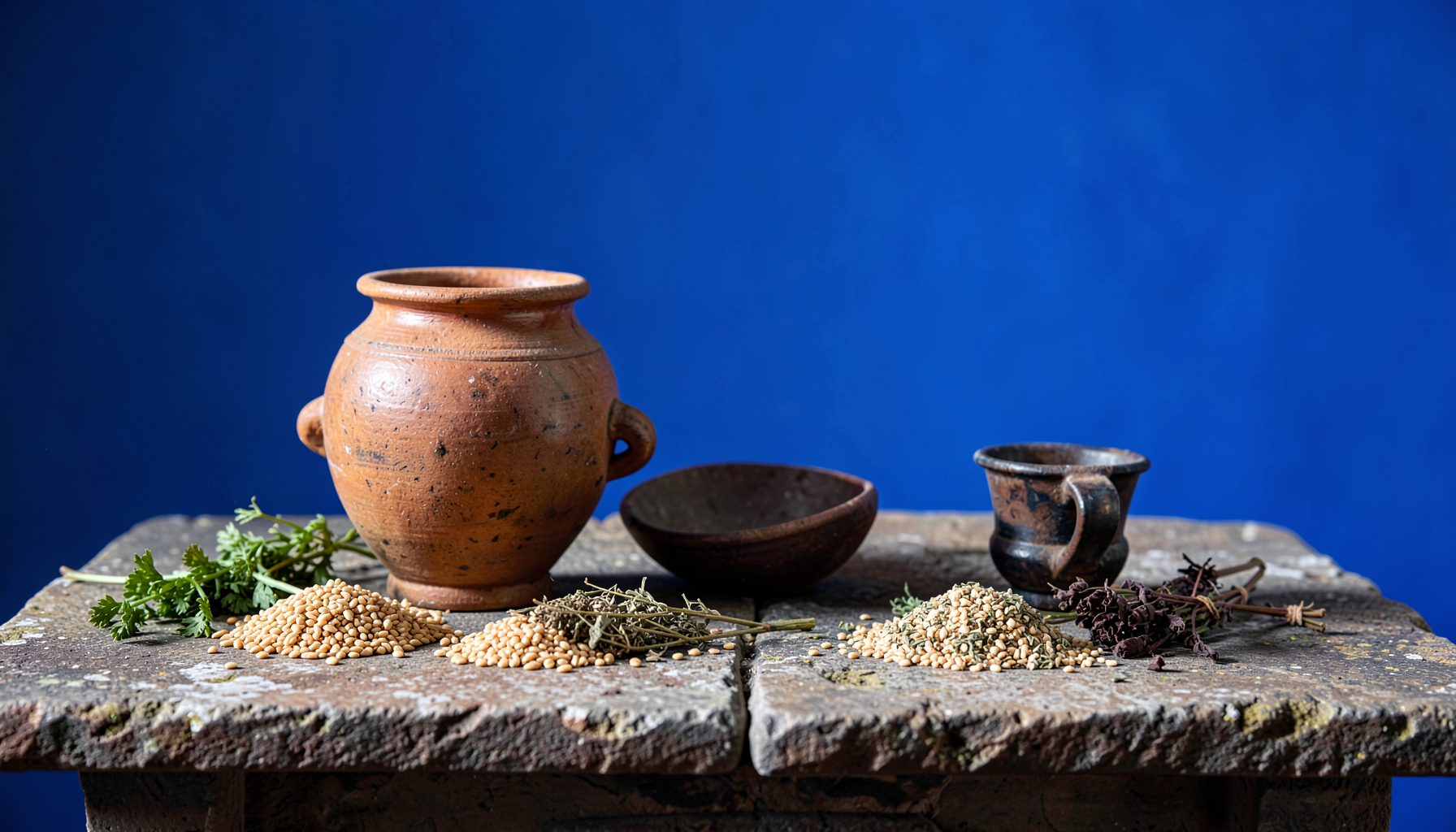
The journey from net to meal involved sorting, cleaning, salting and cooking. Fish could be grilled over charcoal, baked in an earthenware vessel, stewed with herbs or preserved in brine. A cook might use olive oil, wine, vinegar, coriander, oregano-like herbs or fermented fish seasoning, depending on regional practice and household means. Archaeological residues and written recipes can suggest combinations, but they do not always reveal precise quantities or cooking times.
Sweet-and-sour flavour profiles were also possible. Reduced wine syrups were used in ancient Mediterranean cookery, and a modern reconstruction of Roman defrutum helps clarify how concentrated grape must could be produced and applied. It should not be presented as proof of a particular Greek fish recipe, yet it demonstrates how ancient cooks transformed ordinary ingredients into strong flavouring agents for sauces, glazes and marinades.
Evidence, experiment and modern responsibility
Ancient images are valuable but selective. Vase paintings may show a net, boat or fishing scene without explaining its scale, material or precise operation. Literary descriptions can preserve specialised knowledge, though some texts were written long after the practices they describe. Experimental archaeology bridges these gaps by rebuilding plausible gear and testing it in controlled conditions.
Reconstruction must also respect the difference between ancient and modern waters. Fish populations, coastlines, technologies and regulations have changed considerably. In Australia, recreational fishers in Sydney, Perth or Hobart work within state rules governing seasons, licences, bag limits and protected species. A modern reader visiting the Sydney Fish Market during the Christmas seafood rush encounters a commercial supply chain very different from a small Aegean landing beach, even if the final act of choosing a fish for dinner feels familiar.
Public history also benefits from clear boundaries between evidence and imagination. An ancient harbour could contain merchants, sailors, fishers, taverns and gaming spaces, but each claim needs its own support. Even the language used to describe leisure markets today can be slippery, as shown by the varied terminology found in a casino guide. Keeping categories distinct helps a reconstruction remain engaging without turning possibility into certainty.
The ancient Aegean fisher worked with materials that were local, renewable and labour-intensive, reading the sea through wind, colour, depth and animal behaviour. Traps and nets were technologies of observation as much as tools of capture. They reveal coastal communities that organised work collectively, preserved food carefully and adapted their equipment to the smallest details of the shoreline.
For a hands-on reconstruction, begin with a documented net weight or trap form, record every modern substitution and test the equipment in a safe, legal setting rather than in protected waters. Explore the archaeological evidence, prepare a historically informed fish dish and share the results with the same care that ancient fishers brought to their gear.