How Egyptians Made Emmer Bread in Mudbrick Ovens
Bread was the daily foundation of ancient Egyptian food. It appeared in household meals, workers’ rations, temple offerings and tomb scenes, where bakers are shown mixing dough, tending ovens and shaping loaves. The grain most closely associated with this food culture was emmer wheat, a hulled cereal suited to the Nile Valley but very different from the refined bread wheat familiar in Australian supermarkets.
Egyptian bread was produced through a chain of labour that began in the fields and ended beside a hot clay oven. Farmers harvested the grain, household workers removed its husks, millers ground it with stone tools, and bakers turned the flour into dough with water, leaven and sometimes dates, herbs or other grains.
The phrase “bread” covers many products in the ancient evidence. Some loaves were dense and plain, while others were fermented, enriched or shaped for ritual use. The size and quality of bread could also reflect status: an elite household had greater access to careful sieving, fine flour and skilled baking than a poor family relying on coarse meal.
Reconstructing this process today requires a balance between texts, archaeological remains and practical experiment. An Australian cook using a domestic oven in Brisbane, Melbourne or Adelaide cannot recreate every ancient condition, yet the essential sequence—clean, crush, mix, ferment and bake against intense heat—can still be understood and tested.
Emmer and the Egyptian grain supply
Emmer, known scientifically as Triticum dicoccum, retains its husk after threshing. This made it more laborious to process than modern free-threshing wheat, but the crop was well adapted to ancient farming systems. Barley was also important, especially for beer and some types of bread, while emmer occupied a central place in the agricultural economy of the Nile Valley.
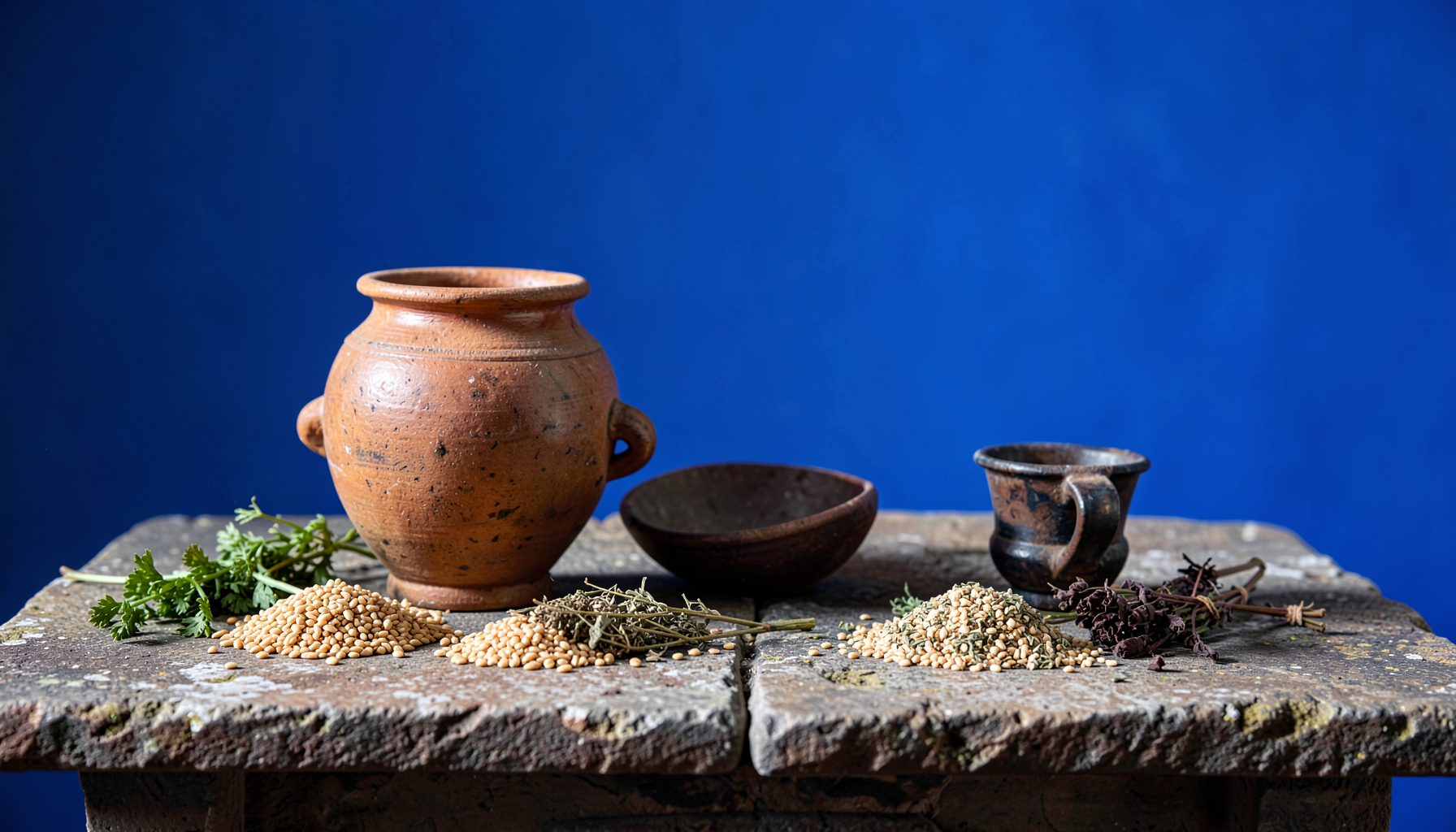
After harvesting, sheaves were threshed to separate grain from straw. Winnowing used air to carry away lighter chaff, but the cleaned kernels still needed dehusking. Ancient workers could pound emmer in a mortar or rub it with abrasive stone surfaces. Heat and moisture may have helped loosen the husk, although the exact treatment varied by period and place.
Grain was valuable enough to function as a ration and a form of payment. Administrative records from Egypt frequently measure cereals in standard units, revealing how bread and beer production depended on organised distribution. A worker’s allowance was therefore more than a meal: it was part of the state, temple or estate economy.
From hulled grain to workable flour
Egyptian grinding was commonly performed with a saddle quern, a slightly curved stone on which grain was crushed back and forth with a handstone. This method produced a flour containing fragments of bran, germ and husk unless the meal was repeatedly sieved. The work was physically demanding and could introduce grit from the stone into the food.
The texture of the flour shaped the final loaf. Coarse meal produced a heavier bread with a distinct chew, while finer flour allowed a more uniform crumb. Archaeological samples and literary references suggest that bread was made in a broad range of qualities rather than according to one fixed recipe. A household might use whatever grain and processing time its resources allowed.
A practical reconstruction can begin with cleaned emmer berries, cracked in a grain mill or powerful blender and then sifted. Modern emmer flour is usually sold without the original husk, so it does not perfectly reproduce ancient milling. It does, however, provide a useful approximation of the nutty flavour and relatively dense structure associated with the grain.
Mixing, leavening and shaping the dough
The basic dough needed flour and water, but ancient bakers understood that time could change it. Dough left in a warm environment would ferment through wild yeasts and lactic-acid bacteria. A portion of old dough could have been retained as a starter, while beer-making environments may also have supplied useful yeast. The evidence does not justify claiming that every Egyptian loaf was sourdough, yet naturally fermented bread was entirely possible.
Salt may have been used, although it was not essential to produce a loaf. Dates, coriander, honey, sesame, animal fat or other flavourings could alter the taste and texture. Some breads were enriched for festivals or offerings, while ordinary rations were likely simpler. Dough was kneaded by hand or in large vessels, then divided into rounds, cylinders or distinctive moulded shapes.
Bread moulds are especially important archaeological evidence. Conical or cylindrical ceramic moulds could hold dough while it baked, giving the loaf a recognisable shape and helping it cook evenly. Other breads may have been placed directly on a hot surface or stuck against the inner wall of an oven, methods still found in various flatbread traditions.
For an Australian kitchen experiment, a small quantity of emmer flour can be mixed with water and a mature starter, then left overnight rather than rushed with commercial yeast. The result will usually be less lofty than a standard white loaf because emmer has a more fragile gluten structure. A baking tray, cast-iron pot or pizza stone can reproduce some of the heat retention of ancient pottery.
Building and firing a mudbrick oven
An Egyptian bread oven was generally made from Nile mud mixed with straw, chaff or other organic temper. Once shaped and dried, the material formed a thick insulating shell. The oven could be domed, cylindrical or beehive-like, with an opening for fuel, air movement and the removal of ashes. Mudbrick construction was practical because suitable clay and plant fibres were locally available.
A fire of wood, straw, reeds or dried animal dung heated the oven before baking. The fuel left embers and ash on the floor, while the thick walls stored radiant heat. Bakers judged readiness through experience: the oven had to be hot enough to set the dough rapidly without burning its outer surface.
| Feature | Ancient Egyptian practice | Modern Australian approximation |
|---|---|---|
| Main grain | Hulled emmer wheat | Commercial emmer or wholegrain wheat flour |
| Milling | Saddle quern and hand sieving | Stone mill, grain mill or coarse home grinding |
| Leavening | Natural fermentation or retained dough | Sourdough starter or a small amount of yeast |
| Oven material | Straw-tempered mudbrick or clay | Pizza oven, cast-iron pot or baking stone |
| Heat source | Wood, reeds, straw or dung | Hardwood, gas or electric heat |
| Bread texture | Dense, nutty and variable | Denser than standard white bread, with a crisp crust |
The interior may have been coated or repaired repeatedly as heat and moisture caused cracking. Bread could be baked in moulds, set on the floor or attached to a heated wall. These methods should not be treated as interchangeable: a wall-baked flatbread needs a different dough and cooking time from a moulded loaf.
Modern Australian fire regulations make a domestic mudbrick oven an impractical project in many suburban settings. Councils in Sydney, Melbourne and other cities regulate open fires, smoke and outdoor construction, while rental properties may restrict permanent installations. A certified wood-fired pizza oven or a well-heated indoor pot is safer for experimental work.
What archaeology reveals about the loaf
Bread production appears in tomb paintings, reliefs and models showing grain preparation, dough work and oven firing. Excavated bread moulds preserve the equipment but rarely the complete recipe. Charred loaves and crumbs offer further clues, including grain mixtures, seeds and the effects of baking temperature. Such evidence must be read carefully because burning, burial and later contamination can alter the original food.
Settlement archaeology also shows that baking could occur at different scales. A household oven served domestic needs, whereas temples, estates and work settlements required larger systems capable of feeding many people. The famous workers’ communities associated with pyramid building demonstrate how bread and beer formed part of organised provisioning rather than being occasional luxuries.
Ancient culinary evidence becomes stronger when material remains are compared with wider food traditions. The study of Greek cooking references shows how literary texts can preserve details about fuel, utensils and eating practices without functioning as straightforward recipe books. Egyptian sources require the same caution: an image can show an activity while leaving its ingredients and proportions uncertain.
Experimental archaeology helps bridge that gap. By making small loaves with emmer, coarse flour and different fermentation times, researchers can observe how hydration, grain preparation and oven heat affect the result. The aim is not to claim that one modern loaf is identical to an ancient one, but to identify which combinations are plausible.
Bread at the table and in ritual
Bread was closely tied to beer, since both depended on cereal processing and fermentation. A worker might receive bread and beer as part of a ration, while temples used loaves in offerings to the gods and in funerary ceremonies. The daily staple therefore moved between ordinary nourishment and religious symbolism.
Shape and presentation carried meaning. Elongated loaves, round loaves and mould-baked breads may have reflected local customs, practical requirements or ritual expectations. Ingredients such as dates or honey could make a loaf more celebratory, but the surviving evidence does not allow every unusual shape to be assigned a specific festival.
The grinding and pounding of food also connect Egyptian practice with later Mediterranean technologies. Roman kitchens used mortars for sauces, spices and grain-related preparations, and the article on Roman mortaria demonstrates how a humble tool can reveal changing culinary habits. Egyptian querns and mortars likewise point to the people and labour behind each loaf.
For modern readers, the most striking feature may be the close relationship between grain, fuel and work. A loaf demanded farmland, water, harvest labour, milling effort, firewood and time. Its apparently simple form concealed an entire economic system, which explains why bread appears so persistently in Egyptian records and images.
Try a small emmer loaf with a naturally fermented starter, coarse flour and a thoroughly heated baking stone, keeping notes on the dough’s texture and rise. Anyone producing bread for sale in Australia should also check the Food Standards Code, including requirements for wheat and gluten allergen declarations, rather than treating an archaeological recipe as exempt from modern food legislation. To share a reconstruction, research observation or event report with the project, contact Archeoricette and help keep ancient foodways connected with careful modern experimentation.