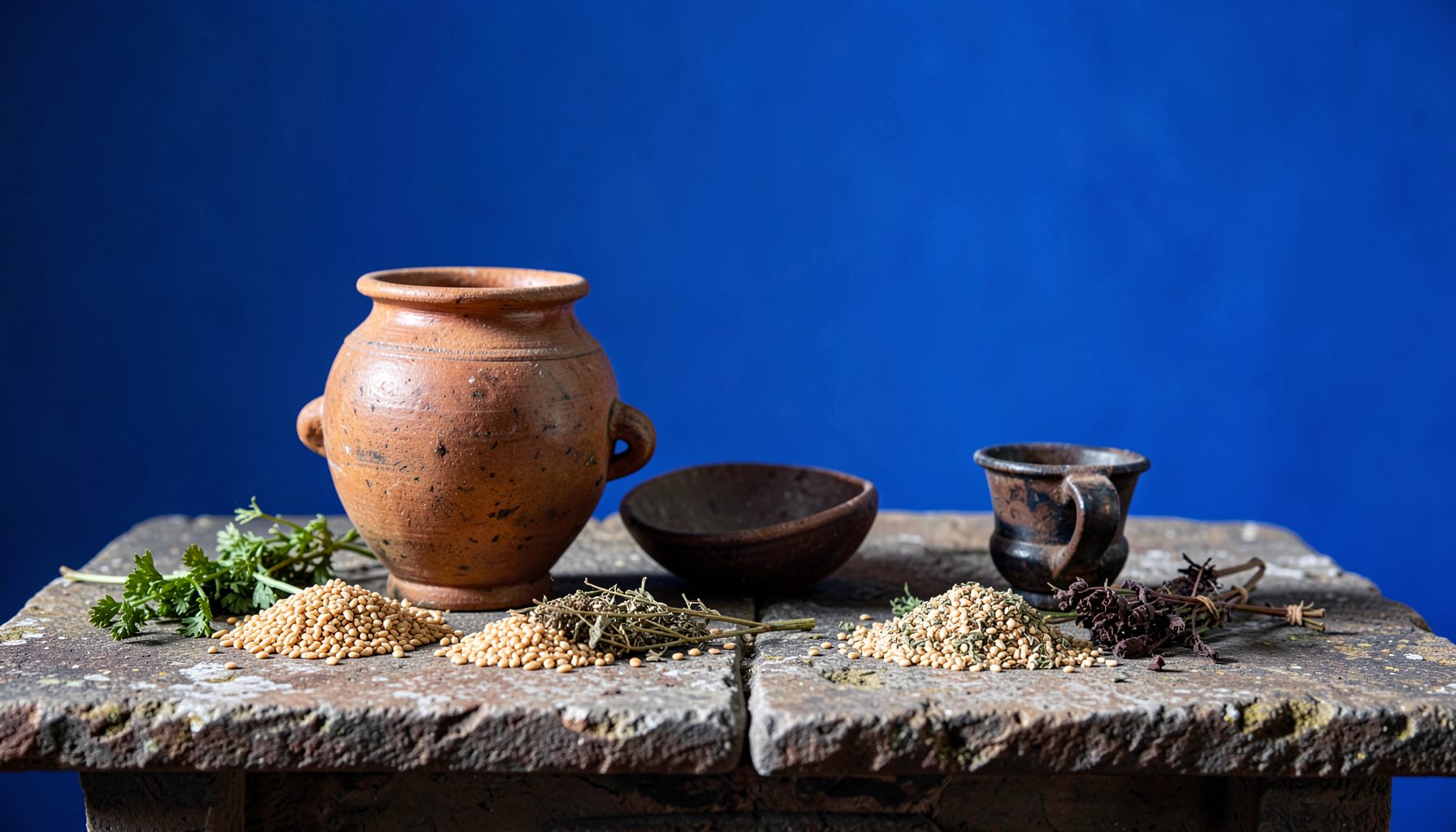
Recreating Greek Lentil Soup From Aristophanes
A bowl of lentils can reveal much about ancient Greek life. It speaks of farming, household economy, fuel, seasonality, and the sharp social humor of comedy. In Aristophanes, humble food often carries a meaning beyond nourishment: it can signal poverty, rustic appetite, military endurance, or the everyday world of ordinary citizens.
The dish discussed here, known as aktos in the modern reconstruction tradition, should not be treated as a perfectly preserved recipe. Aristophanes gives us a literary clue rather than a complete set of instructions. By combining that clue with ancient Greek ingredients, cooking practices, and archaeological evidence, it is possible to prepare a credible lentil soup with a distinctly classical character.
The Comic Clue Behind Aktos
Aristophanes frequently placed food at the center of comic scenes. His characters boast about meals, mock extravagant appetites, and use cheap staples to expose social differences. Lentils belonged to the everyday diet of the ancient Mediterranean, especially among households that could not regularly afford large quantities of meat.
The name aktos is associated with a simple lentil preparation in discussions of Aristophanic food. The surviving literary evidence does not provide an exact recipe, and ancient Greek culinary vocabulary can be difficult to map onto modern categories. It is therefore more accurate to describe this dish as an experimental reconstruction inspired by comedy than as a definitive translation of a written formula.
| Feature | Plausible ancient reconstruction | Modern kitchen equivalent |
|---|---|---|
| Main ingredient | Brown or green lentils | 250 g dried lentils |
| Liquid | Water or light vegetable broth | About 1 litre |
| Seasoning | Salt, olive oil, coriander, cumin, herbs | Adjusted to taste |
| Texture | Thick, soft, and spoonable | Rustic lentil soup |
| Cooking vessel | Ceramic pot over a hearth | Heavy saucepan or Dutch oven |
| Finishing touch | Olive oil, vinegar, or herbs | Drizzle before serving |
The dish becomes historically useful when its limits are made clear. It is not a performance of certainty, but a way to test how a poor or modest household might have turned pulses, water, oil, and aromatics into a filling meal.
Lentils In The Greek Kitchen
Lentils were well suited to the Greek environment. They could be dried and stored for long periods, required no slaughter, and provided a dependable source of nourishment. Their importance becomes especially clear during periods of food restriction, including religious observances and the leaner months before new harvests arrived.
Ancient Greek cooks did not rely on a large collection of specialized sauces. They worked with a smaller but expressive range of ingredients: olive oil, wine vinegar, salt, herbs, coriander seed, cumin, garlic, onions, and sometimes fermented fish products. The final taste could change significantly according to local availability and household wealth.
For this reconstruction, brown or green lentils are preferable to bright orange split lentils. The latter cook quickly and produce a smooth modern soup, while whole lentils create the rustic texture more suitable for an ancient pulse dish. Rinsing is useful, but soaking is optional; traditional cooks could begin directly in the pot and simply allow more time.
Ingredients And Preparation
Use 250 grams of dried lentils, one medium onion, two garlic cloves, two tablespoons of extra-virgin olive oil, one teaspoon of ground coriander, a small pinch of cumin, one bay leaf, and approximately one litre of water. Salt can be added during cooking, while wine vinegar or a little additional olive oil can be used at the end.
The recipe avoids tomatoes, potatoes, carrots, and stock cubes. These ingredients belong to later culinary histories or modern industrial cooking, not to the Greek world of Aristophanes. A small amount of leek could be included as a historically plausible variation, although the simplest version lets the lentils remain the central flavor.
Warm the olive oil in a heavy pot and soften the finely chopped onion over low heat. Add the garlic, coriander, cumin, and bay leaf for less than a minute, taking care not to burn the spices. Stir in the rinsed lentils, pour over the water, and bring the mixture to a gentle simmer.
Cooking A Pot Over The Hearth
Ancient cooks often worked with clay pots placed near embers or suspended above a fire. Heat control was gradual rather than precise. A pot might simmer for a long period while bread was baked, vegetables were prepared, or other household tasks took place. This slow rhythm encouraged pulses to soften and their starches to thicken the cooking liquid.
On a modern stove, cook the lentils uncovered or partly covered for 35 to 50 minutes. Stir occasionally and add water if the soup becomes too thick before the lentils are tender. The finished consistency should be dense but still fluid, closer to a spoonable porridge than a clear broth.
Salt may be added halfway through cooking, though the timing of salting pulses in antiquity is not certain and probably varied. Once the lentils have softened, remove the bay leaf and crush a small portion against the side of the pot. This releases starch and produces a naturally creamy texture without blending the entire dish.
Reconstructing Taste And Texture
The strongest impression should be earthy, warm, and mildly aromatic. Coriander gives the soup a citrus-like perfume, while cumin adds depth without turning the dish into a heavily spiced stew. Olive oil carries these flavors and makes an otherwise austere meal feel richer.
A spoonful of wine vinegar at the end gives the lentils brightness. Acidic ingredients were familiar in Greek cooking, and vinegar could sharpen the flavor of pulses particularly well. Add it cautiously, since the soup should remain balanced rather than sour. Fresh herbs such as coriander leaf are possible, but dried seed is a safer choice for a historically grounded reconstruction.
Experimental cooking works best when each alteration is recorded. One batch might contain only lentils, salt, and oil; another could include onion and coriander; a third might use vinegar at the table. This approach resembles archaeological interpretation: the cook changes one variable, observes the result, and avoids presenting a single modern preference as unquestionable historical fact.
The act of reconstruction can also become a form of sensory learning. Hands-on projects that allow observation, repetition, and creative testing share something with the Reggio Emilia approach, even when the subject is an ancient meal rather than a classroom activity.
Serving A Meal From Aristophanes
Serve the soup warm in small ceramic bowls, accompanied by coarse bread, olives, seasonal greens, or a little salted fish if the household could afford it. Bread would help stretch the meal, while olives and herbs could provide contrast to the soft pulses. The dish is satisfying on its own, but its character becomes clearer when placed among other simple foods.
A generous thread of olive oil over each portion is an appropriate finishing touch. For a sharper flavor, offer vinegar separately so that each diner can season the bowl. This preserves the communal quality of the meal while allowing individual taste, a practical arrangement for a household serving food from a shared pot.
The soup also benefits from being eaten slowly. Its texture changes as it cools, becoming thicker and more porridge-like. That quality is historically meaningful: ancient meals were shaped by fuel, vessels, storage, and the time available for cooking. What looks like a basic recipe today was once part of a broader system of labor and domestic knowledge.
What The Recipe Can Tell Us
Recreating this lentil soup does not prove exactly what Aristophanes’ audience ate on a particular day. It does, however, make several aspects of ancient foodways tangible. Pulses were economical, durable, and adaptable; olive oil transformed their flavor; spices could create variety; and a simple dish could carry social associations in poetry and comedy.
The reconstruction also highlights the difference between textual evidence and culinary practice. A comic playwright may mention food for rhythm, insult, or recognition rather than technical accuracy. Archaeology, botanical evidence, ancient agriculture, and comparative recipes must therefore be used alongside the literary passage.
For readers exploring historical cuisine, aktos is a useful starting point because it connects a surviving cultural text with an accessible kitchen experiment. Prepare it plainly first, then test variations in spice, acidity, and thickness. Record the results and preserve the connection between the bowl on the table and the ancient world that inspired it.
Share your own reconstruction, source discoveries, or tasting notes through the Archeoricette contact page. When publishing or adapting material from the project, consult the site’s legal information and credit the historical and experimental context clearly. Then cook the soup, serve it with bread and olive oil, and let this modest dish bring Aristophanes’ everyday food culture back into the present.