Roman Fish Sauce Production in Pompeii Amphorae and Fermentation Vats
When Mount Vesuvius entombed Pompeii beneath a blanket of ash in 79 CE, it also froze a culinary laboratory in time. The shops, villas, and back-alley workshops of the city held the unmistakable scent of an industry as central to Roman identity as olive oil or wine: the production of garum, the fermented fish sauce that seasoned nearly every dish across the empire. Walk along the Via dell'Abbondanza today and you pass the painted signs of garum merchants, the rectangular platforms of their thermopolia, and the great settling tanks where rivers of fish blood and sea salt once mingled in slow, fragrant transformation.
This research traces that industry from the masonry dolia of the Pompeian workshops to the sea-faring amphorae that carried the finished sauce across the Mediterranean. Along the way it touches on reconstructed recipes, modern sensory experiments, and the surprising resonance that an ancient Roman condiment has found on Australian shores, where chefs and food historians are alert to the kinship between garum and the fermented fish sauces of East and Southeast Asia.
The Pompeian Fish Sauce Industry
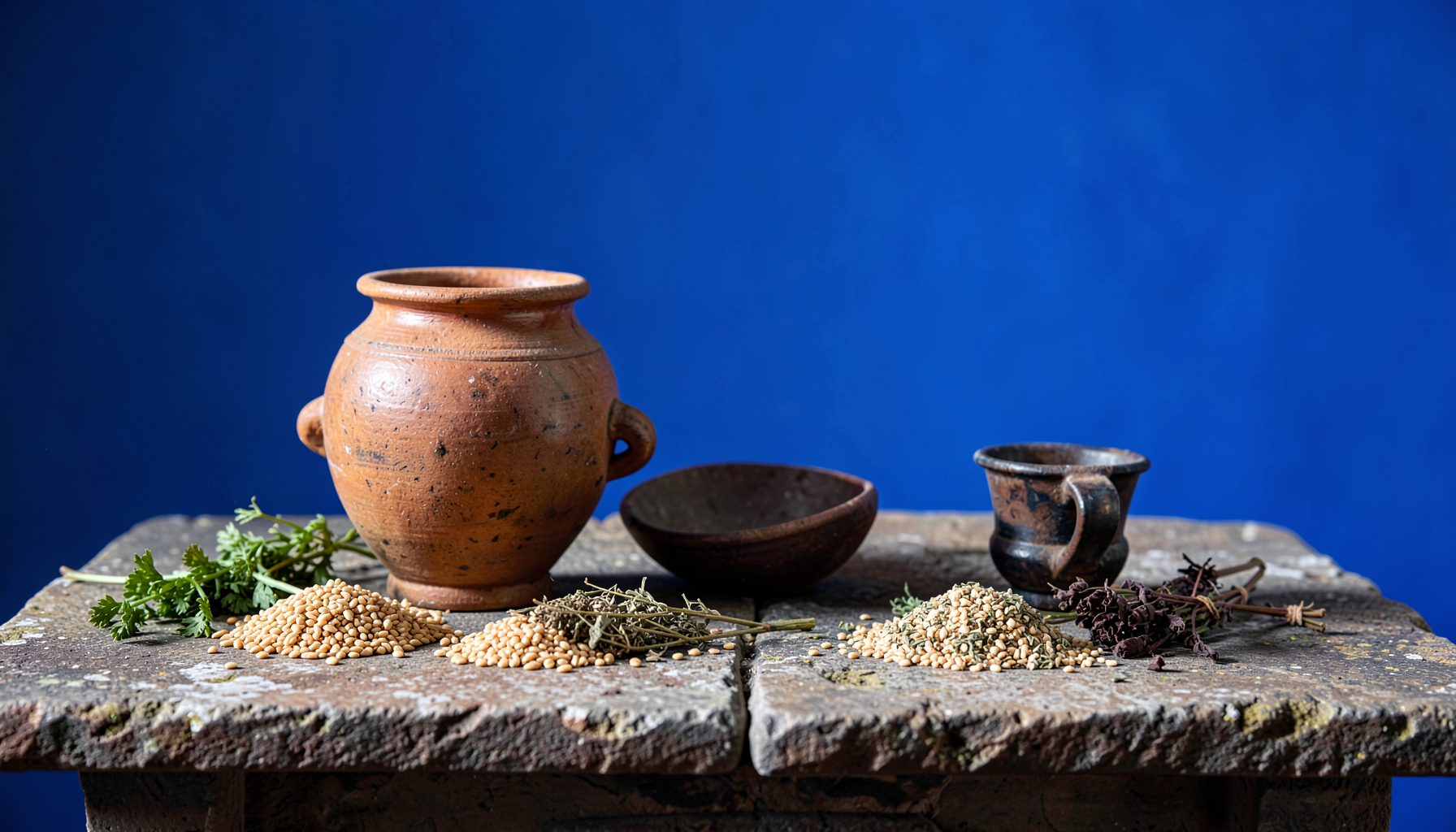
Pompeii was not merely a consumer of garum; it was one of the empire's foremost production hubs. Workshops identified in Regio I and Regio V contained clusters of built-in dolia defossa — large terracotta vessels sunk into masonry counters — arranged in rows suited to bulk fermentation and decanting. One celebrated producer, Aulus Umbricius Scaurus, left dozens of tituli picti on amphorae. His labels advertise ex omnibus bestiis marinis — from all sea creatures — a marketing line suggesting the inclusion of every edible species hauled from the Bay of Naples.
The economic footprint was substantial. A single workshop could produce several thousand litres per season, and the trade connected Pompeian merchants with distant markets from Britannia to the Black Sea. By the late first century CE, the city stood behind only certain North African and Baetic centres in total output. This scale required an infrastructure of carters, coopers, salters, and shippers whose presence is recorded in tomb inscriptions and dedicatory altars scattered through the city.
Amphorae Shapes and Trade Networks
The carinated silhouettes of Pompeian garum amphorae are the most durable signature of the trade. Most local production travelled in Dressel 7/8 vessels, with narrow cylindrical necks, sharply angled shoulders, and tapering bases that nested efficiently in ship holds. Inscriptions appeared in two registers: a painted titulus describing the contents, origin, and consular dating, and often a dipinto naming the merchant. The Pompeian workshops developed regional variants, including the distinctive Dressel 12 with its wheel-ridged body.
These containers dispersed the sauce through networks that touched every coastal province. Recovered examples appear at Cosa, Ostia, and the frontier forts along the Danube. Comparative finds at the Athenian Agora show that Pompeian garum competed against the better-known products of the Iberian factories. Such wide distribution required rigorous standardisation, which the painted labels anticipated. The depth of the trade explains why the typology of fish-sauce amphorae has become a cornerstone of Roman economic archaeology, allowing a single sherd in a distant context to illuminate entire Mediterranean provisioning circuits.
The Fermentation Process Unearthed
Direct evidence for production comes from the masonry installations in several Pompeian workshops. The dolia themselves were partially subterranean, dug into opus signinum floors and sealed with stone-weighted lids. Around them, archaeologists have recovered mortars, bone chisels, and bronze ladles consistent with the written sources. Pliny the Elder and Strabo describe the layered maceration of fresh fish viscera with coarse sea salt, often in ratios approaching one part fish to three parts salt by volume.
The vessels were left exposed to open air and strong sunlight for two to three months. Solar heat accelerated enzymatic breakdown, releasing the amino acids and peptides that produced the famed umami depth. Periodic stirring encouraged controlled putrefaction rather than rot, while a layer of floating fish oils prevented excessive oxidation. The Pompeian climate — hot, dry summers and mild winters — was ideal, although workshops continued through cooler months by shifting jars into warmer interior rooms. The resulting liquid carries an identical biochemical profile to modern Asian fish sauces, which explains why sensory panels consistently describe the colour as dark mahogany, the aroma as intensely savoury, and the finish as long and salty.
Grades, Varieties, and Commercial Vocabulary
Roman consumers recognised a hierarchy of products well beyond the generic category of garum. Trade customs differentiated between a clear amber elite sauce, a medium-bodied table condiment, an oily residue scraped from the fermenting jars, and a watery brine drained off as a by-product. Each carried its own commercial name, price band, and culinary use. The vocabulary extended to provenance: waters around Carteia in Hispania or the lagoons near Neapolis were advertised by name as guarantors of superior flavour, much as a modern champagne house invokes terroir.
| Roman Fish Sauce Grades | Primary Material | Texture | Typical Use and Price Position |
|---|---|---|---|
| Garum optimum / flos | Blood, fresh viscera, premium small fish | Clear amber liquid | Table luxury, expensive |
| Liquamen | Mixed whole small fish and salt | Smooth liquid | General cooking, mid-priced |
| Hallex | Coarse sediment pressed from jars | Dense paste | Family cooking, inexpensive |
| Muria | Drained residual brine | Thin, salty liquid | Pickling, utilitarian, lowest |
Such a stratified market left visible traces on the amphorae: finer grades were packed in cleaner vessels, sealed with pine resin, and shipped under named brand stamps.
Archaeological Evidence from the Vesuvian Sites
The Vesuvian region offers an unmatched density of material. Herculaneum has yielded a garum shop with jars still in situ and a wall painting showing fish being cleaned and layered in tall vats, a rare visual confirmation of the textual accounts. Pompeii's Regio I preserves the masonry counter of a workshop where seven dolia remain embedded, while plaster casts of wooden implements reveal the tools used to agitate the brew. Carbonised residues recovered from these vessels are now being analysed by biomolecular archaeologists, with isotopic signatures consistent with marine proteins and high salt concentrations.
Inscriptions and graffiti complete the picture. A graffito from a Pompeian tavern depicts two containers labelled liquamen alongside a wine amphora, hinting at how the product was retailed in small measure to ordinary diners. Altar dedications to Venus Pompeiana and Neptune, found near the harbour area, are thought to thank the gods for safe cargoes of the sauce, a fitting detail for an industry that depended on sea and sun alike.
Experimental Reconstruction in the Modern Kitchen
The past two decades have seen garum move from scholarly journals to working kitchens. Researchers such as the French food historian Patrick Faas have published scaled recipes using local mackerel or sardines layered with sea salt in glass jars, left on sunny windowsills for sixty to ninety days, then strained through cheesecloth. The finished sauce tastes uncannily like the Asian fish sauces on supermarket shelves, the single most striking confirmation that Roman product and Eastern successors arise from similar biochemistry rather than coincidence.
An Australian cohort has joined this movement. At the University of Sydney's food studies program, students have reconstructed Pompeian-style liquamen using locally caught slimy mackerel, while chefs in Brisbane and Melbourne drizzle house-made garum over roasted carrots or fold it into cured-egg yolk pasta. The work dovetails with broader reconstructions of classical feasting, such as temple feasting at Delphi, and with projects supported by the Australian Archaeological Institute at Athens. Tasting panels regularly compare these reconstructions with commercial Asian fish sauces, finding consistent agreement on umami intensity and salt balance.
Pompeian Fish Sauce on the Australian Palate
Australia sits on the edge of the Indo-Pacific, where fermented fish liquids have seasoned kitchens for centuries. The Sydney Fish Market, the largest of its kind in the Southern Hemisphere, moves more than fifteen thousand tonnes of seafood each year and stocks an array of Asian-style fish sauces alongside locally fermented alternatives from producers in Tasmania and along the Victorian coast. Tasting panels compare these products against reconstructed Pompeian recipes, with consensus on umami intensity and on the way the sauces behave in braising liquids or vinaigrettes.
This dialogue is also academic. Macquarie University's ancient history department hosts seminars on Mediterranean trade, while La Trobe researchers have sampled garum replicas in sensory trials reminiscent of those run by coffee or olive oil tasters. Regional restaurants are catching on as well: a Carlton eatery in Melbourne has paired garum-dressed flathead — a quintessentially Australian species — with roasted fennel in a menu titled From Pompeii to Port Phillip. Such crossovers show that a sauce invented two thousand years ago on the slopes of Vesuvius still has much to teach the way Australians eat and think about the deep history of food.
A century and a half of archaeology has turned the garum workshops of Pompeii into a working laboratory for Roman food history, and the unfinished business is broad. Recipes, fermentation temperatures, residue chemistry, and the comparative study of Asian and Mediterranean fish sauces are all fields where careful, patient research is needed, and where independent scholars can contribute alongside major institutions. Anyone curious about the methodology of this project, the experimental protocols, or the resources used to reconstruct ancient Roman dishes can read the about page of this site. For collaborations, lectures, or enquiries about workshops and tastings, the contatti page lists every way to get in touch. Consider subscribing, sharing a reconstruction of your own, or contributing to a future article — the kitchens of Pompeii still have lessons to offer the modern table.