Roman Household Bread with Emmer and Sourdough
A Roman household loaf was shaped by the grain available, the tools at hand, and the rhythm of fermentation. Emmer wheat, known in Latin as far, was an important cereal in early Roman food culture, valued for its reliability and suitability for porridge, cakes, and bread. When combined with a naturally fermented starter, it produces a dense, fragrant loaf with a nutty flavour and a pleasantly tangy crumb.
This reconstruction adapts ancient practice to an Australian kitchen without pretending that a modern oven can reproduce every condition of a Roman bakery. The aim is to recover the character of the bread: stone-ground or lightly milled emmer, a sourdough culture, restrained seasoning, and patient baking. It is a practical way to explore how ordinary Roman families may have transformed a stored grain into a daily staple.
Emmer And The Roman Grain Supply
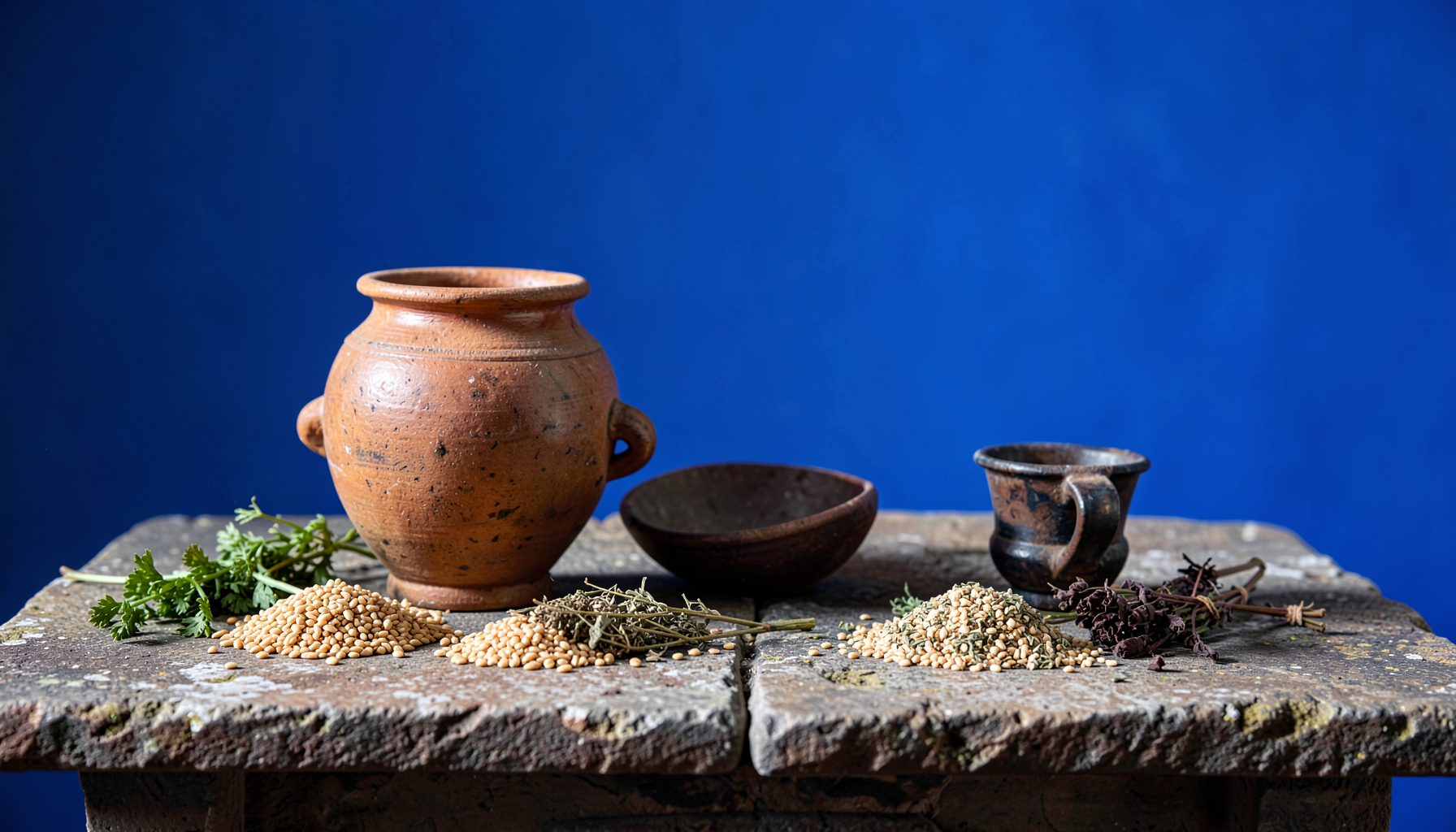
Emmer is a hulled wheat, meaning that its husk remains attached after threshing and requires extra processing before the grain can be milled. This made it less convenient than free-threshing wheats, but the crop was well suited to Mediterranean agriculture. It tolerated relatively poor soils and formed part of the long agricultural history that preceded Rome’s imperial grain system.
The Latin word far could refer to emmer or to a preparation made from it, depending on context. Early Roman identity was closely connected with grain agriculture, and emmer retained a symbolic place even as softer wheats became increasingly important for fine flour. A household might use coarser meal for everyday bread while reserving more carefully sifted flour for festive or ritual foods.
Australian cooks may find emmer flour through specialist grain suppliers, organic shops, or farmers’ markets in cities such as Melbourne, Sydney, Adelaide, and Canberra. Packaging varies considerably: some products are labelled “emmer”, while others use “farro”, a modern Italian term that can refer to emmer, spelt, or einkorn. Checking the botanical description or asking the miller is worthwhile if historical accuracy matters.
Sourdough Before Commercial Yeast
Roman bakers did not have packets of instant yeast, yet they understood that a portion of fermented dough could raise the next batch. Pliny the Elder describes methods involving saved dough and fermentation, while archaeological and textual evidence points to the use of souring agents in bread production. The exact formula differed between households and bakeries, so a single “Roman sourdough” recipe would be too definite.
To begin a modern version, mix 50 grams of wholemeal emmer flour with 50 grams of water in a clean jar. Feed it daily with equal weights of flour and water until it becomes active, smells pleasantly sour, and rises predictably after feeding. In a warm Australian summer, fermentation may move quickly; in a cool Hobart or Canberra kitchen, the starter may need extra time or a warmer position.
A mature starter adds acidity, aroma, and structure, but emmer dough can become fragile if it is mixed aggressively or fermented for too long. Its gluten is present, so this bread is not suitable for people with coeliac disease or wheat allergy. In Australia, wheat must be declared as an allergen under food labelling requirements administered through the Food Standards Code, a useful reminder that “ancient grain” does not mean allergen-free.
Mixing And Shaping The Loaf
For one medium loaf, combine 500 grams of emmer flour with about 350 grams of water, 100 grams of active starter, and 10 grams of salt. The final hydration may need adjustment because flour from different mills absorbs water differently. Start with less water if the flour is finely milled, then add small amounts during mixing until the dough is soft but not runny.
Rest the flour and water for 30 minutes before adding the starter and salt. This brief pause allows the grain to hydrate and reduces the need for intensive kneading. Work the dough with gentle folds every 30 minutes for two hours, then leave it to ferment until visibly expanded. Shape it into a round or oval and place it seam-side up in a floured basket or cloth-lined bowl.
A Roman household would probably have used hand judgement rather than a fixed recipe. The dough may have been baked as a single round, several small loaves, or flattened cakes, depending on the household’s oven and meal. A simple scored cross is a practical modern mark, though scoring itself should not be presented as a universal Roman rule.
Comparing Ancient And Modern Approaches
The following comparison separates likely ancient principles from choices made for a contemporary Australian kitchen. It is useful when adapting the loaf without confusing reconstruction with certainty.
| Element | Roman household possibility | Modern Australian adaptation | Effect on the loaf |
|---|---|---|---|
| Grain | Emmer meal or flour, often less finely sifted | Wholemeal or white emmer flour from a specialist mill | Nutty flavour and a close, slightly dense crumb |
| Raising agent | Saved fermented dough or souring culture | Mature wheat sourdough starter | Tang, aeration, and longer keeping quality |
| Mixing | Hand mixing in a bowl or trough | Gentle folds during bulk fermentation | Protects emmer’s comparatively delicate dough |
| Seasoning | Usually restrained; salt availability varied | Measured sea salt | Clearer flavour and improved dough strength |
| Oven | Wood-fired domestic or communal oven | Preheated Dutch oven or baking stone | Better steam retention and a stronger crust |
| Baking shape | Round loaf, flat cake, or small household breads | One boule or two small loaves | Easier portioning and more even baking |
Salt deserves particular care. Roman salt was widely used, but access and quality varied by region and period. A modern loaf can easily become saltier than its ancient counterpart, especially when using a strongly flavoured mineral salt. A modest quantity allows the grain and fermentation to remain central.
Baking With Australian Equipment
Heat the oven to 240°C, using a Dutch oven if available. Place the shaped dough on baking paper, score the surface, and lower it into the preheated pot. Bake covered for 20 minutes, then remove the lid and continue at 210°C for another 25 to 30 minutes. The loaf should be deeply coloured and sound hollow when tapped.
A baking stone with a tray of boiling water can provide an alternative, although a covered pot is generally easier in a dry domestic oven. This matters in Australia, where air conditioning, low indoor humidity, and hot summer kitchens can change the speed of fermentation and the rate at which a crust forms. In a Brisbane kitchen, the dough may need shorter proofing; in Melbourne winter, it may require a longer rise.
The finished bread should cool completely before slicing. Fresh emmer bread can seem gummy if cut while hot, particularly when it contains a high proportion of wholemeal flour. Once cooled, it should have a firm crust, an earthy aroma, and a moist crumb that is heavier than a modern white sourdough.
Eating Bread In A Roman Household
Bread was a vehicle for other foods as much as a dish in its own right. It could accompany olives, legumes, vegetables, cheese, salted fish, or meat, and stale pieces might be softened in broth or used to absorb sauces. The same loaf therefore belonged to everyday eating, hospitality, and the practical economy of avoiding waste.
For a historically themed meal, serve slices with a sharp sheep’s milk cheese, lentils dressed with herbs, or roasted vegetables. A small portion of honeyed cheese can recall the ritual world of Roman offerings; the recipe for Roman libum offering provides a useful comparison between a leavened household staple and a ceremonial cheese cake.
Sweet and sour flavourings also belonged to Roman food culture. A drizzle of reduced grape must offers a more period-sensitive alternative to modern balsamic glaze, and the discussion of Roman must explains how unfermented grape juice could be transformed into a concentrated culinary ingredient. For a more unusual historical pairing, the study of ancient rhubarb trade illustrates how long-distance trade connected food, medicine, and prestige well beyond the Roman household.
The bread can be part of an Australian gathering without losing its historical focus. Serve it at a weekend lunch in Sydney, alongside local legumes or seasonal vegetables from an Adelaide market, while explaining that the recipe is an informed reconstruction rather than a preserved domestic formula. That distinction gives the loaf its value: it turns archaeological evidence into a sensory experiment while leaving room for uncertainty.
Bake a loaf, record how your emmer behaves in your own climate, and compare the result with the grains and fermented breads available in your region. Each batch offers a small, tangible way to investigate Roman foodways through taste, texture, and technique.