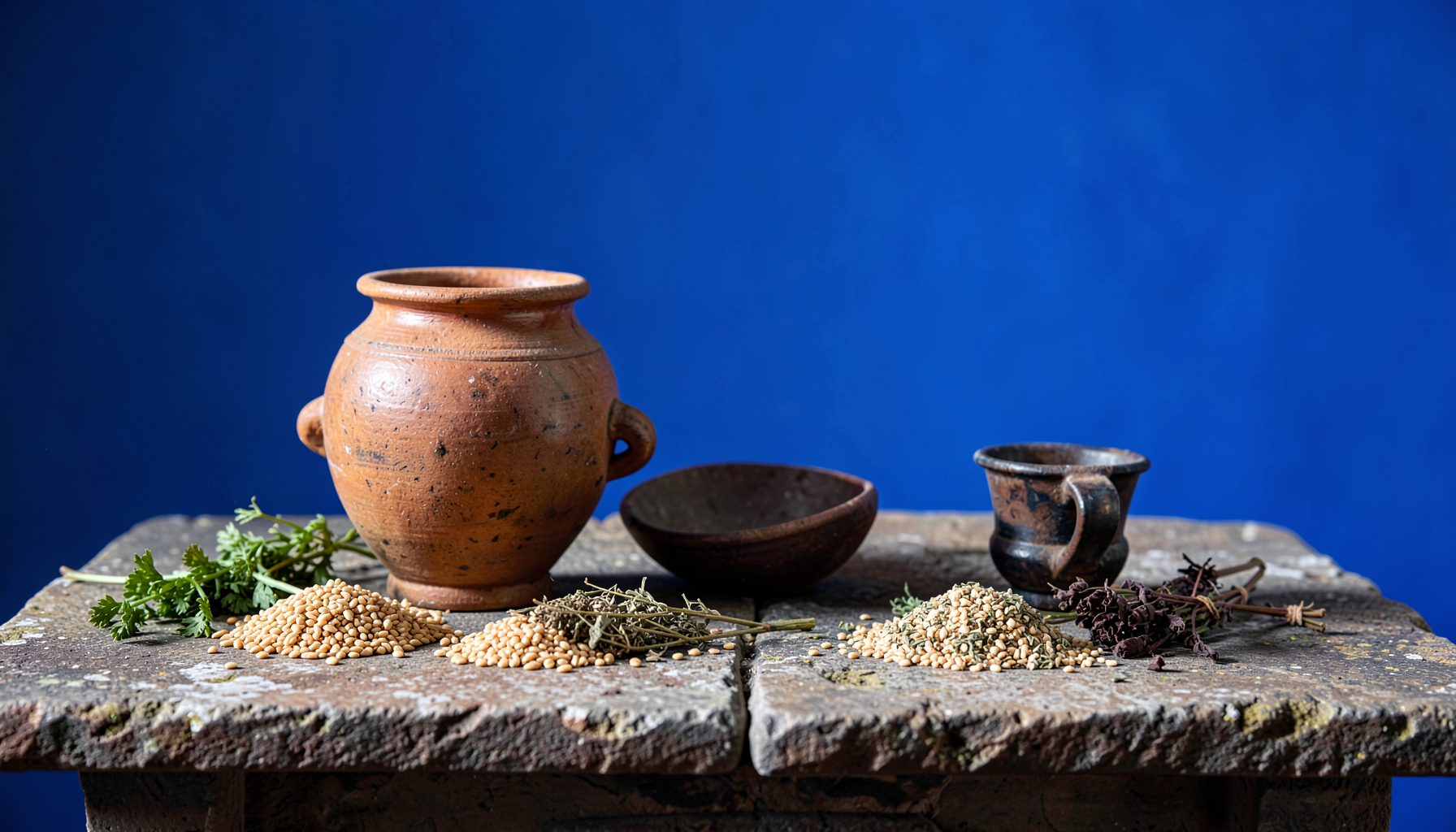
Roman Kitchen Gardens Through Pliny the Elder’s Eyes
A Roman kitchen garden was a productive space where food, medicine, scent and household identity met. In the writings of Pliny the Elder, the hortus appears as far more than a decorative patch of green. It supplied vegetables for daily meals, herbs for remedies, flowers for religious use and plants that revealed the reach of Roman trade.
Pliny’s Natural History preserves a remarkably rich record of ancient horticulture. Books XVIII and XIX discuss farming and gardens, while Books XX and XXI turn to the medicinal and perfumed properties of plants. His account combines practical observation, inherited agricultural knowledge, stories from earlier authors and the Roman fascination with rarity.
For modern readers, these descriptions offer a way to reconstruct ancient foodways without pretending that every Roman household cultivated the same crops. A wealthy villa, an urban apartment and a small rural farm had different resources. Yet the basic idea remains recognisable in Australia: a productive garden can connect everyday eating with climate, seasonality, health and cultural memory.
The Hortus As A Household Food Supply
Pliny treats the garden as an important part of agricultural life, especially when discussing vegetables that could be harvested close to the home. Leafy greens, onions, garlic, leeks, cabbages, lettuces, beetroot-like plants, radishes and herbs belonged to a practical food economy. These crops did not require the acreage associated with grain, vineyards or olive groves, and many could be gathered repeatedly.
The Roman hortus was also a flexible space. It might sit beside a modest dwelling, within a villa estate or in a carefully arranged urban property. Its produce could be eaten fresh, preserved, boiled, dressed with oil and vinegar, or added to pulses and grains. Pliny’s catalogue suggests a cuisine in which vegetables were not merely garnishes. They were central ingredients with their own flavours, textures and reputations.
This matters when interpreting Roman recipes. A dish based on greens, alliums and herbs need not be treated as a side dish in the modern sense. It may represent the main vegetable component of a meal, particularly for households relying on cereals, beans and seasonal produce. The garden helped make a varied diet possible without depending entirely on meat.
Plants, Remedies And Roman Knowledge
Pliny does not divide food and medicine as sharply as contemporary readers often do. A plant could be eaten for nourishment, applied to the body, used in a drink or prescribed for a particular complaint. Garlic, for example, was valued as a strongly flavoured food and credited with medicinal powers. Cabbage attracted a long list of claims, while mint, rue, fennel and coriander occupied the borderland between seasoning, household remedy and cultivated herb.
His descriptions should be read as historical evidence rather than a modern medical guide. Pliny records claims that reflect Roman theories, local practices and earlier Greek authorities. Some observations concern taste, cultivation or storage; others belong to a world of pharmacology, ritual and natural marvels. The value lies in seeing how Romans classified plants according to several overlapping uses.
Garden plants could also carry social meanings. Rare varieties and imported seeds signalled access to trade and wealth, while familiar greens expressed frugality and domestic competence. The same Roman culture that praised simple rural habits could admire extravagant produce at elite tables. Pliny’s work preserves this tension between the ideal of the self-sufficient garden and the appetite for novelty.
The relationship between food and social ritual can be explored alongside Greek symposium customs, where drinking, conversation and appetisers created a different setting for displaying ingredients and hospitality. Roman gardens belonged to household production, yet their contents could move into formal dining and public ideas of refinement.
What Pliny’s Garden Might Have Contained
The following overview brings together plants associated with Pliny’s discussions of cultivation, food and household use. Modern names are approximate, since ancient botanical categories did not always correspond neatly to contemporary species.
| Plant or crop | Likely culinary role | Other Roman associations | Useful modern comparison |
|---|---|---|---|
| Cabbage | Boiled, dressed or combined with other vegetables | Digestive and medicinal claims | Cool-season brassica in southern Australian gardens |
| Leek | Soups, stews and vegetable dishes | Household food and remedy | Easy crop for beds or large pots |
| Garlic | Seasoning, sauces and cooked dishes | Protective and medicinal reputation | Hardy crop suited to many Australian regions |
| Lettuce | Fresh salads and early-season greens | Table food and garden variety | Common in Sydney and Melbourne home gardens |
| Radish | Fresh, sliced or cooked | Sharp flavour and medicinal uses | Fast-growing crop for small spaces |
| Fennel | Leaves, seeds and aromatic seasoning | Digestive and medicinal value | Useful perennial or seasonal herb |
| Mint | Sauces, drinks and flavouring | Household remedy and fragrance | Productive pot plant in Australian conditions |
| Beet | Leaves and roots | Food and medicinal discussion | Suitable for cool-season cultivation |
Pliny also reflects interest in varieties. Size, colour, flavour, season and place of origin could all affect a plant’s reputation. A Roman writer might distinguish between forms of the same crop in ways that resemble modern heirloom culture. This is a reminder that “Roman vegetables” were not a fixed list. They belonged to changing landscapes shaped by selection, exchange and cultivation.
For an Australian reconstruction, climate requires care. A recipe may call for a plant that grows readily in Canberra’s cooler conditions but struggles through a humid Brisbane summer. In Melbourne, winter greens and leeks can fit naturally into a seasonal garden, while Perth growers may need to adjust sowing times and irrigation. The historical principle is more useful than a rigid planting calendar: choose crops that match the season and use them while fresh.
From Ancient Garden To Australian Kitchen
Contemporary Australian households often encounter the kitchen garden through balconies, raised beds, allotments and community plots rather than large private estates. A Sydney balcony can support mint, coriander, lettuce and spring onions in containers. In Melbourne, community gardens provide shared growing space and preserve local knowledge among gardeners from many cultural backgrounds. These settings echo the ancient connection between cultivation, cooking and neighbourhood exchange, even though the legal and environmental context is different.
Water is a major practical consideration. Gardeners in Adelaide, Perth and parts of regional Australia may need to plan around dry conditions, while tropical growers face heavy rain, humidity and pest pressure. State and territory water restrictions can affect when and how gardens are irrigated. A historically inspired project should therefore avoid wasting water for the sake of visual authenticity and favour mulching, containers with good drainage and seasonal planting.
Australian biosecurity legislation also shapes what can be grown and shared. Seeds, plant material and soil cannot be moved freely across all borders, and restrictions may apply between states or territories. Local nurseries and reputable seed suppliers are safer sources than importing ancient-looking varieties. Food safety rules matter as well when produce is sold at a farmers’ market, served at a public event or prepared for others. Historical cooking is most convincing when it respects the present legal landscape.
At a farmers’ market in Melbourne, Sydney or Hobart, shoppers may find heirloom tomatoes, heritage grains, leafy greens and locally grown herbs that invite comparison with ancient crop diversity. These products are not Roman survivals, but they can help cooks think about seasonality, regional supply and the sensory differences between fresh produce and supermarket-standard varieties.
Reconstructing Pliny’s Garden At Home
A small experimental plot can begin with a few reliable crops rather than an attempt to reproduce every plant in Pliny’s encyclopaedia. Garlic, leeks, lettuce, radishes, fennel, mint and cabbage offer contrasting textures and scents. Grow mint in a container because it spreads aggressively, and place fennel where its height will not shade smaller greens. In warm regions, adjust planting times so tender leaves are not forced through the hottest part of summer.
The garden should be treated as a research tool. Record sowing dates, weather, watering, harvest size and flavour. Compare young and mature leaves, raw and cooked preparations, and different dressings based on olive oil, vinegar, herbs and fermented fish sauce. This process can reveal why Roman writers valued particular plants: bitterness, pungency, fragrance and texture become tangible rather than merely descriptive.
Pliny’s garden also encourages attention to preservation. Greens could be cooked immediately, while seeds, bulbs and aromatic herbs offered longer storage. Drying, salting, pickling and infusing extended the usefulness of a harvest. Modern cooks can explore these methods with appropriate food-safety practice, remembering that ancient technique does not automatically mean safe technique. Refrigeration, clean equipment and tested preservation guidance belong in any contemporary reconstruction.
For readers who want to place garden evidence within a wider study of ancient food, the project’s published books provide a route into recipes, historical research and experimental archaeology. The most rewarding reconstructions bring together text, material evidence and taste without claiming certainty where the sources remain incomplete.
A Roman kitchen garden was a living archive of household priorities. Pliny’s descriptions show how cultivation supported meals, remedies, status and seasonal rhythms, while also revealing the limits of ancient botanical knowledge. Try growing a small selection of historically attested plants, cook them simply, and keep notes on what changes from seedbed to plate. For research, workshops or collaboration with Archeoricette, use the contact page to connect the garden experiment with the wider study of ancient foodways.