The Roman Trade in Black Pepper from India and Its Cost in Silver
Black pepper was one of the Roman world’s most recognisable luxuries, yet it was more than a finishing spice shaken over a dinner dish. Its movement from India to the Mediterranean depended on monsoon sailing, Egyptian ports, caravan transport, imperial taxation and a dense network of merchants. The small blackcorns found in Roman kitchens therefore carried the history of the Indian Ocean into dining rooms in Rome, Pompeii and provincial towns.
For modern Australians, the story can feel surprisingly familiar. A small jar of pepper in a Melbourne grocer or a spice stall at Sydney’s Paddy’s Markets looks inexpensive and ordinary. In antiquity, however, pepper represented long-distance trade and a meaningful outlay of silver. Reconstructing its price helps place Roman food culture within the wider economies of labour, transport and status.
From the Malabar coast to Roman Egypt
The principal source of Roman black pepper was the southwestern coast of India, especially the Malabar region of present-day Kerala. Roman merchants and their intermediaries knew ports such as Muziris and Nelcynda, which appear in the Periplus of the Erythraean Sea, a first-century guide for sailors and traders. Pepper grew inland, but coastal ports gathered it into export cargoes alongside pearls, textiles, gemstones and aromatics.
The route depended on seasonal winds across the Arabian Sea. Sailors leaving the Red Sea could use the southwest monsoon to reach India, then return with the northeast monsoon. This shortened the voyage compared with coastal hopping, although it demanded careful timing and considerable nautical knowledge. Pepper was loaded into ships bound for ports such as Myos Hormos and Berenike on the Egyptian Red Sea coast, then carried by desert caravans towards the Nile.
Roman consumers also encountered other forms of pepper. Long pepper, probably Piper longum, was valued for its stronger, warmer flavour, while white pepper was made by removing the outer skin from ripe berries. Black pepper was produced from unripe drupes that were dried until their surface wrinkled and darkened. These distinctions mattered in ancient recipes and in pricing, much as distinctions between Tasmanian pepperberry, ordinary supermarket pepper and single-origin spices matter in Australia today.
A commodity moved by sea, desert and river
After crossing the Indian Ocean, pepper entered a carefully organised Egyptian transport system. Goods were unloaded at Red Sea harbours, moved by pack animals across the Eastern Desert, and transferred to river craft on the Nile. Alexandria then served as a major redistribution centre, sending eastern imports towards Italy and other Mediterranean markets. The journey involved port fees, guards, brokers, sailors, camel drivers, warehouse keepers and tax collectors.
The state benefited from this commerce through customs duties and control of strategic routes. Roman administration did not mean that every shipment belonged to the government, but imperial authority made the corridor possible and profitable. Archaeological finds at Berenike, including imported pottery, coins, botanical remains and inscriptions, show how cosmopolitan these ports were. Pepper was part of a much broader exchange linking the Mediterranean with East Africa, Arabia and South Asia.
The ancient trade also explains why pepper could be present at very different social levels. A wealthy household might purchase large quantities and use it freely in sauces, while a modest cook could use a small amount for special meals. In a culture where spices signalled access to distant goods, the visible presence of pepper at a banquet helped communicate the host’s resources. The same principle appears in the study of food and status at Pompeii, where dining arrangements and ingredients worked together to express rank.
What did pepper cost in silver?
Ancient prices are difficult to convert into modern money because Roman currency changed over time and because surviving figures often refer to different points in the supply chain. Pliny the Elder complained that India drained enormous sums from Rome, giving a figure of 50 million sesterces a year for eastern luxuries. His estimate probably grouped pepper with other valuable imports, so it should not be treated as a precise pepper invoice.
A more useful reference comes from prices recorded for pepper in Roman literary and administrative contexts. Pliny reports a price of four denarii per Roman pound for black pepper, although the date, quality and market position behind the figure remain uncertain. One denarius originally contained about 3.9 grams of silver, and a Roman pound, or libra, weighed roughly 327 grams. Four denarii therefore represented about 15.6 grams of silver for around 327 grams of pepper.
That calculation suggests roughly 48 grams of silver per kilogram at the cited price. It is a useful approximation rather than a universal tariff. A shipment bought at an Indian port would have cost less than pepper sold in Rome after freight, losses, taxation, storage and merchant profit. Currency debasement also complicates comparisons: a denarius in the early empire did not have exactly the same precious-metal value as one issued centuries later.
| Measure | Approximate ancient figure | Silver interpretation |
|---|---|---|
| Roman pound of pepper | 327 g | A little over one-third of a kilogram |
| Reported price | 4 denarii | About 15.6 g of silver in an early imperial calculation |
| Estimated silver per kilogram | — | About 48 g of silver |
| Roman pound in modern weight | — | Comparable to a generous 300 g packet |
| Main caution | — | Quality, date, tax and retail margin could alter the price |
Silver was a meaningful economic measure because it connected pepper with wages, military pay and household purchasing power. It does not mean that Roman shoppers handed over loose silver filings for a peppercorn measure. Coins were the practical medium, and the final price depended on local supply. The silver estimate instead reveals the intensity of the long-distance exchange: a modest weight of spice embodied a substantial quantity of refined metal.
Pepper in recipes, medicine and social display
Roman cooks used pepper in sauces, meat dishes, fish preparations, vegetable combinations and sweet foods. It was commonly ground with a mortar, often alongside herbs, vinegar, wine, dates, honey or fermented fish sauce. The flavour could cover strong ingredients, sharpen bland ones and create a pungent profile prized by elite diners. Recipes in Apicius frequently call for pepper, sometimes in quantities that suggest a well-stocked kitchen rather than an occasional luxury.
Pepper also belonged to Roman medicine. Galenic traditions associated pungent spices with warming and digestive properties, while household practice treated them as useful ingredients in compounded remedies. These medicinal uses increased demand and blurred the boundary between pantry and apothecary. The same spice could season a sauce, flavour a wine or enter a preparation intended to treat bodily imbalance.
Social meaning was equally important. Imported ingredients could demonstrate a household’s participation in imperial networks, especially when served at a formal convivium. This did not make every peppered dish extravagant, but it made pepper a persuasive symbol of reach and refinement. A Roman host could display the empire through a mortar, a storage jar and a sauce whose ingredients had travelled thousands of kilometres.
Ancient food traditions also show that expensive ingredients were often combined with humble staples. Sesame, honey and grain could become festive foods in the Greek world, as illustrated by these Greek wedding cakes. In Mesopotamia, dates provided sweetness and energy in breads and cakes, a tradition explored through Sumerian date bread. Pepper belonged to this same broader pattern: prestige ingredients gained meaning through their combination with everyday foods.
Reconstructing an ancient pepper experience
A modern reconstruction should begin with the ingredient itself. Black pepper from Kerala is the closest broad modern comparison to the pepper traded through Roman Egypt, although ancient varieties, processing methods and grading systems cannot be replicated exactly. Freshly grinding whole peppercorns gives a sharper aroma than using pre-ground powder, whose volatile compounds fade during storage.
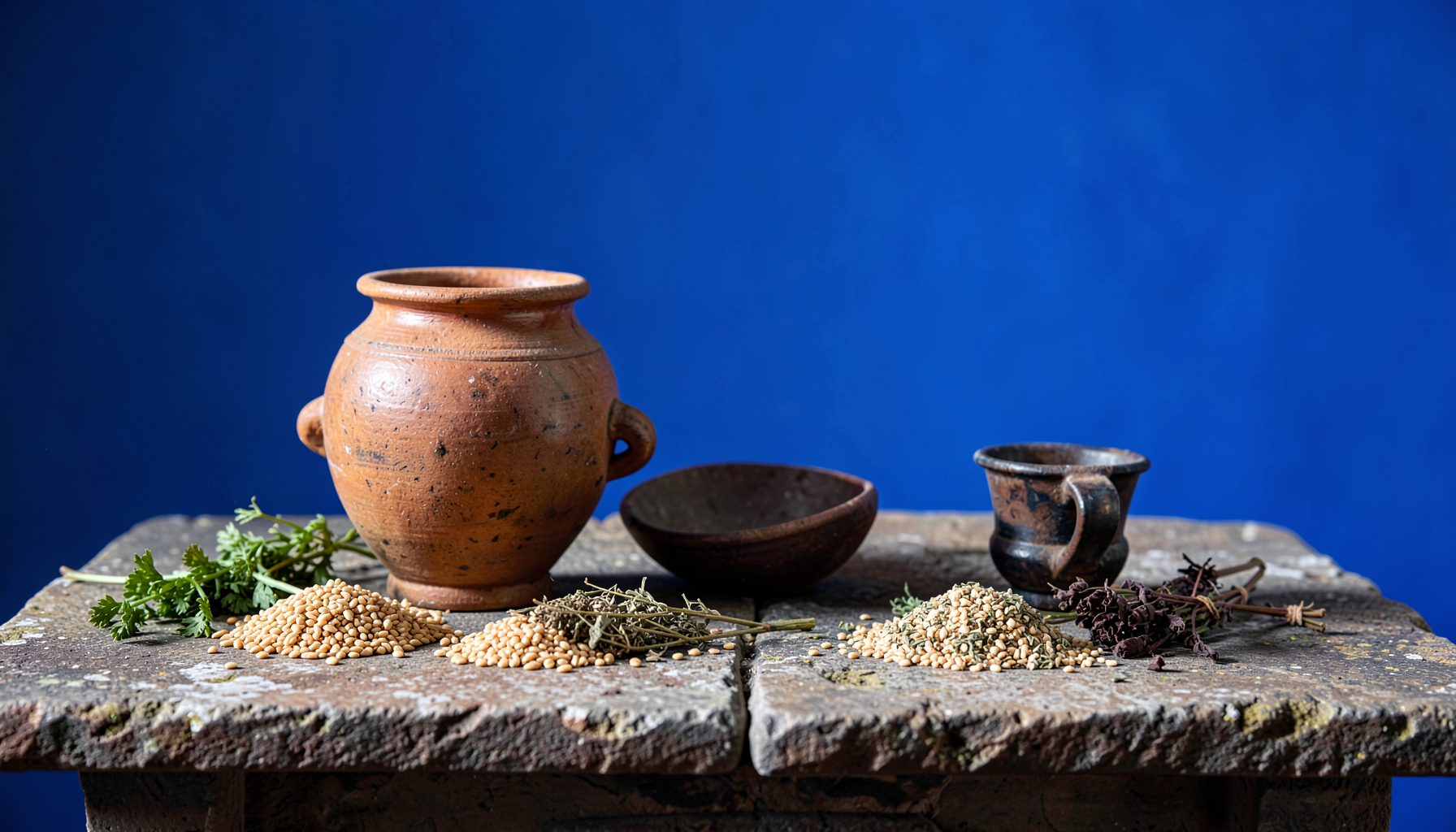
The equipment matters as well. A stone or ceramic mortar produces a different texture from a high-speed electric grinder. Roman cooks could make a coarse crush, a fine powder or a paste with wine, vinegar, oil and other ingredients. For an Australian kitchen, a small granite mortar from a kitchenware shop in Brisbane or Adelaide can approximate the physical action, while a standard pepper mill provides a more convenient but less historically revealing alternative.
The local market also changes the experience of cost. A 50-gram jar on a supermarket shelf in Perth may make pepper appear almost valueless because modern shipping, mechanised agriculture and global distribution have reduced its price. A specialist spice merchant in Melbourne may offer several grades at very different prices, making quality and provenance visible again. Comparing those products with a Roman estimate encourages careful thinking about packaging, retail margins and purchasing power rather than a simplistic conversion into Australian dollars.
For anyone cooking an ancient-style sauce, salt, acidity and fish sauce should be balanced before adding large amounts of pepper. Roman recipes often produce a complex seasoning paste rather than a single dominant pepper flavour. Start with whole black pepper, crush it shortly before cooking and record the quantity. This makes it possible to distinguish the effect of the spice from the effect of honey, wine, dates or fermented ingredients.
Ways to interpret the evidence responsibly
No single ancient text provides a complete price list, and archaeology rarely preserves the full path from Indian farm to Roman table. The strongest interpretation combines literary evidence, coin studies, shipping history, botanical remains, inscriptions and experimental cooking. It also keeps separate the price paid at origin, the wholesale price in Egypt and the retail price in Italy.
For readers in Australia, the following principles help connect the ancient evidence with a modern kitchen without flattening the historical differences:
- Treat silver conversions as estimates based on coin weight, date and purity.
- Distinguish black pepper, long pepper and white pepper rather than using “pepper” as a single category.
- Consider freight, customs, storage and merchant margins when imagining the final Roman price.
- Compare ancient weights with familiar Australian packet sizes, but avoid direct Australian-dollar equivalence.
- Use whole peppercorns and a mortar when reconstructing Roman preparation methods.
- Read recipes alongside evidence for status, medicine, trade and household organisation.
- Remember that a spice could be both a daily seasoning and a public sign of wealth.
The Roman trade in black pepper from India was therefore a story of agricultural production, maritime timing and silver flowing through connected economies. Its value lay in flavour, preservation, medicine and display, but also in the distance compressed into every small measure. Grind a few peppercorns beside a Roman-style sauce and the ancient Indian Ocean trade becomes tangible: a global history held in the palm of a modern Australian cook. Explore the wider ancient foodways through reconstructed recipes and archaeological research at Archeoricette.