The Mesopotamian house of fishes: carp and catfish from the Tigris
The Tigris River carved the earliest civilisations of humanity, and along its muddy banks the people of Sumer, Akkad, Babylon, and Assyria developed one of the most sophisticated food cultures of the ancient world. Among the many provisions drawn from this great waterway, freshwater fish — particularly carp and catfish — held a place of surprising importance on tables ranging from humble workers' quarters to royal banquets. Cuneiform tablets, archaeological middens, and temple records all confirm that fish was a daily staple, a trade commodity, and a sacred offering.
Modern Australian cooks exploring ancient recipes will find the parallels surprisingly close. The Murray-Darling river system once supported Indigenous communities with freshwater fish for thousands of years, and today Australian fish markets in Sydney's Pyrmont or Melbourne's Queen Victoria Market still celebrate the catch from river and sea. Reconstructing a Mesopotamian fish dish in a suburban Adelaide or Brisbane kitchen is far more feasible than it might sound, especially when local ingredients stand in for those that grew on the alluvial plains between the Tigris and Euphrates.
The Tigris as a living larder
The Tigris was not merely a geographical feature but a sustained source of protein, fat, and flavour for the inhabitants of ancient Mesopotamia. Fish appear in the earliest Sumerian literature, including hymns and administrative texts that describe the daily rations of temple workers and the offerings presented to the gods. Archaeological digs at sites such as Ur, Uruk, and Lagash have uncovered fish bones in domestic middens alongside tools — bone needles, net weights, and copper hooks — that speak to a well-organised fishing industry.
Carp species populated the slower stretches of the Tigris and its marshy backwaters, while large Siluridae catfish dominated the deeper channels. These were not incidental catches but staple foods. Texts from the Third Dynasty of Ur record fishermen delivering fixed quotas to temple complexes, suggesting that fish was institutionalised in the same way as barley or dates. The economic weight of the catch is also evident in legal texts that fixed prices and penalties for poaching in royal waters, and fish was a critical ration for soldiers on campaign, a continuity explored in military history archives.
Australian readers can draw a direct comparison with the Murray cod, a large freshwater predator that once dominated the southern river systems. Like the Mesopotamian catfish, the Murray cod was central to the diet of riverside communities and features prominently in the cultural memory of the area. Both rivers supported civilisations whose relationship with aquatic protein shaped everything from religious ritual to daily labour, and both fish remain symbols of regional identity.
Fishing and preparation techniques
Ancient Mesopotamian fishermen used a combination of methods. The simplest involved spears or harpoons, effective in the shallow margins where catfish lurked near the bottom. More sophisticated were the woven nets, weighted with stone or clay sinkers, that could be deployed from reed boats. Fish traps made from bundled reeds created a passive system, guiding the fish into narrowing channels where they could be easily scooped up. Bone awls and copper knives recovered from sites suggest that the catch was processed quickly, often on the banks or on the boats themselves.
Once caught, the fish were cleaned, scaled, and often split open for drying in the sun or smoking over fires. Archaeological evidence suggests that some fish were fermented or salted for long-term storage, creating a product not unlike modern fish sauce. The Mesopotamians understood that preserving the catch was essential for feeding cities, armies, and labourers during the off-season or in times of flood.
The parallels with Indigenous Australian fishing techniques are striking. Traditional stone and woven branch fish traps in the Barwon River system functioned on the same principles as the reed traps of the Tigris. Both cultures understood fish behaviour, seasonal movements, and the engineering of capture. This shared ingenuity is one reason the historical recipes translate so well to modern kitchens that respect traditional ecological knowledge and the deep history of river cultures.
Seasoning the catch: aromatics, sauces, and fermentation
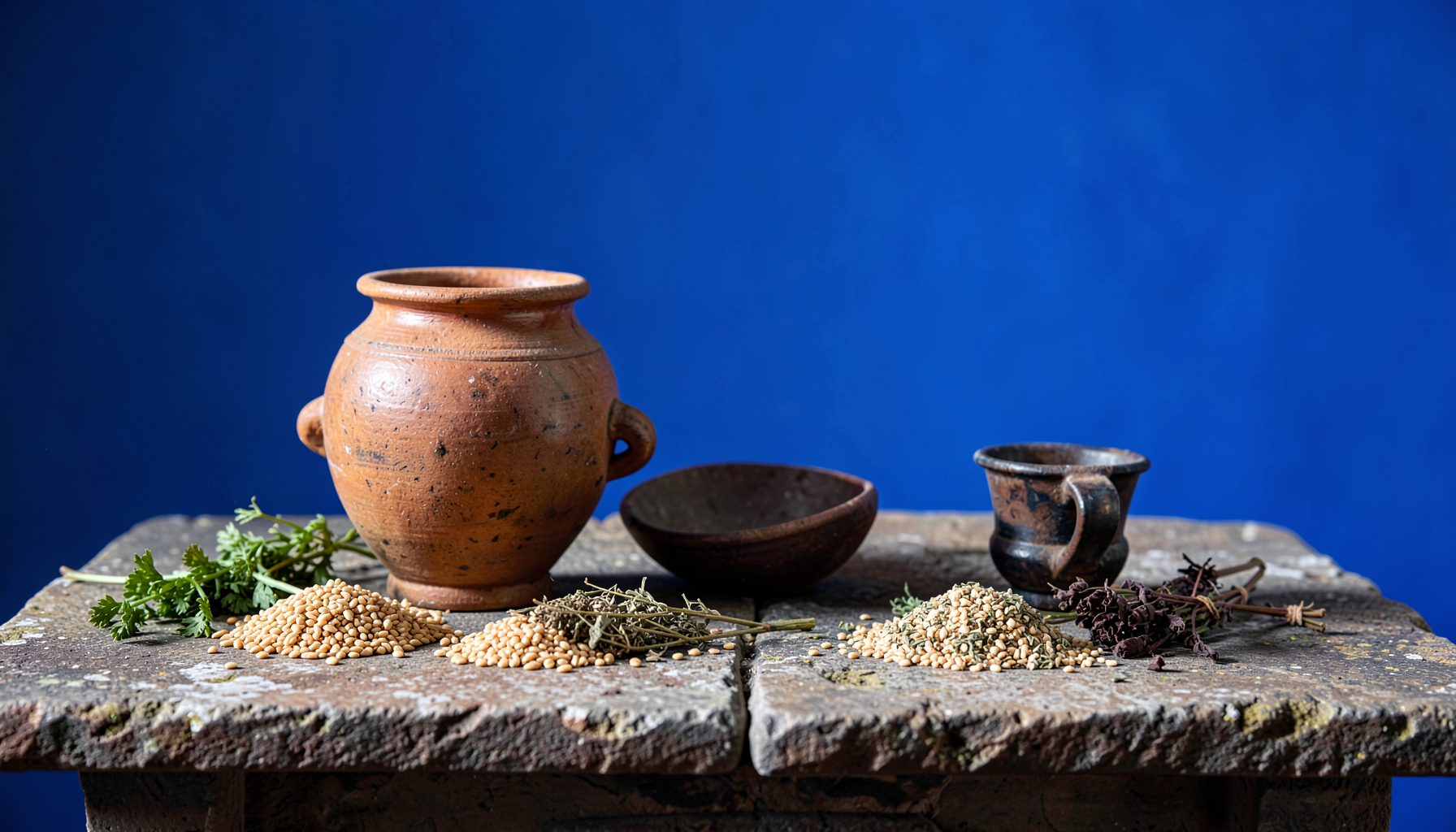
Mesopotamian cooks did not simply grill or boil their fish without embellishment. The cuisine of the region relied on a sophisticated palette of aromatics: coriander, cumin, garlic, leek, and dill all appear in cuneiform recipes preserved on clay tablets. These herbs were pounded into pastes, mixed with sour fermented dairy or the brine from salted fish, and used to coat or stuff the fish before cooking. Some recipes even call for the fish to be wrapped in fragrant leaves before being placed in clay ovens.
The fermented fish sauce produced in Mesopotamia was a precursor to the Roman garum and the modern Southeast Asian fish sauces that are now staples in Australian pantries. In fact, the relationship between ancient Mesopotamian fish condiments and later Mediterranean traditions is well documented, and a fascinating exploration of how the Romans applied similar principles to vegetables can be found in how the Romans seasoned vegetables with garum and olive oil. The continuity of these fermentation traditions across millennia is one of the most remarkable threads in global culinary history.
Modern cooks in Australia can approximate these flavours using readily available ingredients. A dressing of quality soy sauce, a squeeze of lemon, and a sprinkle of fresh dill can evoke the herbal, salty character of the ancient sauce. Local herbs like lemon myrtle or native mint can add a uniquely Australian twist to the herbal profile, connecting the ancient recipe to the modern landscape.
Sacred fish: religion and ritual on the Tigris
Fish served as both food and sacred symbols in ancient Mesopotamia. Certain species were associated with specific deities, and offerings of fish appear in temple inventories and ritual texts. The city of Eridu, considered the oldest city in the world, had a temple to Enki, the god of water and wisdom, where fish played a central role in the daily offerings. Fish were also linked to fertility and abundance, and their appearance in art and literature reinforced their cultural significance beyond mere nutrition.
The ritual slaughter and preparation of fish followed strict rules, not unlike the kosher or halal traditions of later religions. Priests ensured that the fish were caught in a state of purity and prepared according to ancient formulae. This spiritual dimension added another layer to the already complex culinary culture of the Tigris, making the fish course a meaningful act as well as a delicious one.
This respect for fish as more than mere protein is a value shared by many modern communities, including Indigenous Australian groups who view certain species as totemic or sacred. The continuity of this reverence, from the temples of Sumer to the rivers of New South Wales, demonstrates the deep human need to connect food with meaning and place.
Reconstructing the dishes in a modern kitchen
Reconstructing a Mesopotamian fish dish begins at the market. In Australia, fresh carp is occasionally available through specialty suppliers, though catfish is more commonly found as imported basa or in frozen form. Barramundi, while primarily saltwater, offers a similar firm texture and is widely available at major retailers like Coles and Woolworths. For a more authentic experience, visitors to the Sydney Fish Market or Adelaide's Central Market can often find farmed Murray cod or silver perch that behave similarly to ancient Tigris species in the pan.
A basic reconstruction might involve scoring the fillets, marinating them in a mixture of olive oil, lemon juice, crushed garlic, and toasted cumin, then grilling them over high heat. The Mesopotamians would likely have cooked over open fires or in clay ovens, and modern charcoal grills replicate this flavour well. Served with flatbread and a fresh salad of cucumber, mint, and yoghurt, the dish becomes a bridge between the ancient Near East and a contemporary Australian dinner table.
For those interested in plant-based adaptations of ancient recipes, resources like Danielle's vegan kitchen offer inspiration for reimagining these flavours without the fish itself, though purists will insist on the original fermented element. The techniques of salting, drying, and fermenting that were perfected on the Tigris remain standard practice in many modern cuisines, from Italian colatura di alici to Vietnamese nuoc mam.
The study of ancient Mesopotamian cuisine is ongoing, with new translations of cuneiform tablets appearing regularly and experimental archaeologists continuing to test old recipes in modern kitchens. For those who wish to dive deeper into the foods of the ancient world, the Archeoricette project offers a growing library of guides, reconstructions, and historical essays that bring these forgotten flavours back to life. The Tigris may no longer flow through Australian backyards, but its culinary heritage can certainly find a place on the modern plate, whether in a home kitchen in Perth or a community cooking class in Hobart.