How Romans Made Moretum, A Pounded Herb And Cheese Spread
Moretum was a rustic Roman preparation of herbs, cheese, garlic, oil and vinegar pounded together into a dense relish or spread. It belonged to the everyday food culture of the Mediterranean rather than the grand banquet: a little mortar work could turn simple farm ingredients into a strongly flavoured accompaniment for bread, vegetables or grilled meat.
The dish is especially valuable for understanding ancient cooking because its method survives more clearly than an exact recipe. Roman writers describe pounding, seasoning and balancing flavours, while the ingredients remain familiar enough for a modern kitchen. For Australian cooks, it offers a practical way to explore ancient foodways with produce from a local greengrocer, a farmers’ market or a backyard herb garden.
What Moretum Was In Roman Food Culture
The Latin word moretum is associated with a pounded mixture, and the preparation is often linked with the Appendix Vergiliana, a collection of poems traditionally connected with Virgil. In the poem commonly called Moretum, a farmer prepares his morning meal by grinding garlic, herbs, cheese, salt and oil before spreading the result over bread. The scene is humble, domestic and physical: the mortar is central to the meal.
This was not a smooth dip in the modern hummus sense. The texture would have depended on the strength of the pounding, the dryness of the cheese and the amount of oil added. A coarse paste could retain visible flecks of green and white, while longer grinding produced something closer to a thick herb cheese.
The flavour profile was direct. Garlic supplied heat, fresh herbs brought fragrance, aged cheese gave salt and umami, and vinegar sharpened the mixture. Moretum could therefore make plain bread satisfying, especially in a rural household where wheat, olives, cheese and garden plants formed the foundation of daily eating.
For wider background on ancient recipes, ingredients and reconstructed dishes, the Archeoricette archive provides a useful point of reference for connecting literary evidence with experimental cooking.
Ancient Sources And What They Tell Us
The poem’s most important evidence is its sequence of actions. Garlic is crushed first, then herbs are added, followed by cheese, salt, oil and vinegar. This order makes culinary sense: the hard, pungent bulb needs the greatest force, while delicate leaves should be incorporated after the mortar contains a workable base.
Cato the Elder’s agricultural writing also preserves related instructions for pounding herbs and flavourings. Roman recipe evidence rarely behaves like a modern cookbook, with precise weights and cooking times. Instead, it assumes practical knowledge. The cook recognises when a paste is sufficiently integrated, when the salt is adequate and when the oil has loosened the mixture.
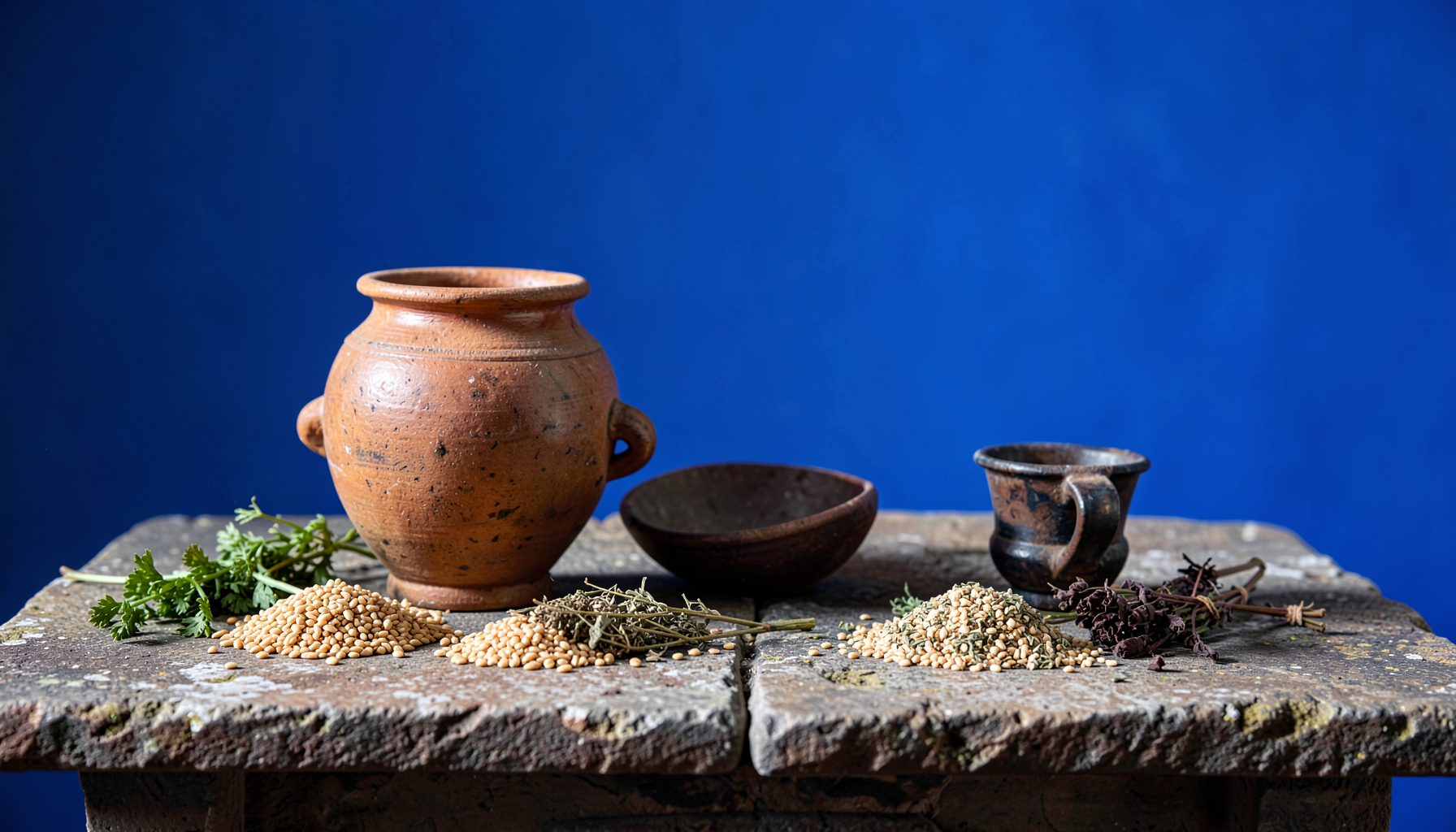
The Roman mortar was usually made from stone, ceramic or another durable material with a rough internal surface. It was a cooking tool, a processing bowl and sometimes a marker of domestic labour. Pounding released aromatic oils from leaves and broke down cheese into a cohesive mass in ways that a modern electric processor would accomplish almost instantly.
The dish also sits within a broader network of Mediterranean food exchange. Garlic, coriander, cumin, pepper, wine vinegar and imported seasonings moved through Roman markets, while regional cheeses and herbs gave each household its own version. Moretum was simple, but simplicity did not make it culturally uniform.
Ingredients For A Historically Informed Version
A sensible reconstruction begins with a firm sheep’s or cow’s milk cheese. Pecorino is a strong choice because its saltiness and dry texture resemble the type of aged cheese that grinds well. A mature Australian pecorino, parmesan-style cheese or firm goat cheese can work too, although a very moist feta will produce a softer and wetter spread.
Use fresh coriander, parsley, mint, rocket or garden cress according to the version you want to explore. The ancient poem mentions several herbs, but translating plant names is not always straightforward. Coriander gives a citrusy, green flavour; mint adds coolness; parsley provides a restrained background; and rocket contributes peppery bitterness.
Garlic should be present but controlled. Two small cloves are enough for a bowl serving four people, particularly when the cheese is already powerful. Add extra virgin olive oil gradually, then use red wine vinegar or a mild grape vinegar to bring acidity. Salt may be unnecessary if the cheese is highly seasoned.
Some reconstructions include asafoetida, an intensely aromatic resin used in parts of Roman cooking, though it should be treated as an optional historical experiment rather than a default ingredient. The guide on Roman asafoetida explains how to handle its unusual flavour without overwhelming the dish.
A Practical Australian Pantry
Australian cooks can adapt the method without losing its character. Choose ingredients that preserve the original balance of pungency, salt, green fragrance and acidity rather than trying to reproduce a single fixed formula.
Useful substitutions include:
- Pecorino for a firm, aged Australian cheese
- Flat-leaf parsley, coriander or mint from a local market
- Red wine vinegar instead of reconstructed grape vinegar
- Cob loaf, sourdough or flatbread for serving
Markets offer an especially good setting for this experiment. Melbourne’s Queen Victoria Market, Sydney’s farmers’ markets and Adelaide Central Market all make it possible to compare local herbs, regional cheeses and different grades of olive oil. In Brisbane or Perth, a community garden or suburban herb patch can provide the leafy ingredients at their freshest.
For a small mortar batch, gather:
- 2 garlic cloves
- 80 g firm aged cheese
- 1 packed cup mixed fresh herbs
- 2 tablespoons olive oil and 1 teaspoon vinegar
These quantities are a modern working ratio, not a Roman measurement. Begin with less liquid and add it slowly. The finished paste should hold its shape on bread, not run across the plate.
Comparing Historical And Modern Methods
The following comparison shows how a reconstruction can remain faithful to the ancient technique while using equipment available in an Australian kitchen.
| Element | Roman-style approach | Modern practical approach |
|---|---|---|
| Main tool | Stone or ceramic mortar and pestle | Heavy mortar, or a bowl and sturdy pestle |
| Cheese | Firm sheep’s, goat’s or cow’s milk cheese | Pecorino, parmesan-style cheese or aged local cheese |
| Herbs | Garden herbs chosen by availability | Parsley, coriander, mint, rocket or cress |
| Liquid | Olive oil with vinegar or wine acidity | Extra virgin olive oil and red wine vinegar |
| Texture | Coarse to smooth paste from pounding | Hand-pounded paste; processor only for a quick approximation |
| Serving | Spread on bread as a meal or relish | Bread, roasted vegetables, grilled meat or a cheese board |
Hand-pounding matters because the process changes the flavour. Crushing garlic against the rough surface of a mortar releases its juices, while bruised herbs become fragrant rather than merely chopped. A food processor cuts quickly but can make the paste wet, uniform and aerated.
If speed is essential, pulse the garlic and cheese briefly, add the herbs, then finish by hand with oil and vinegar. This preserves some of the texture and keeps the preparation connected to the ancient method. A blender is less suitable because it encourages over-processing and often requires too much oil.
The wine element can also be explored at the table. A dry, fresh Italian-style white or a restrained Australian white wine will suit the salty, herbal spread. Readers interested in wine culture and regional food traditions can explore Gambellara’s wine heritage alongside the Roman habit of pairing simple foods with locally available drinks.
Making Moretum Step By Step
Place the peeled garlic in the mortar with a pinch of salt. Pound until it becomes a rough paste, scraping the sides regularly. Add the herbs in handfuls, crushing each addition before adding more. The mixture will darken and become noticeably aromatic as the leaves release their oils.
Add the cheese gradually. Rotate the pestle rather than striking only downward, using pressure to rub the ingredients together. When the paste looks cohesive, drizzle in the olive oil while continuing to work the mixture. Finish with vinegar a few drops at a time, tasting as you go.
The ideal result is savoury, sharp and green, with enough body to sit on a slice of bread. If it tastes flat, add a little vinegar; if it is too aggressive, increase the cheese or herbs. If it is dry, use oil sparingly, since an ancient-style moretum should remain dense.
Serve it fresh with warm bread, crisp vegetables or roasted mushrooms. It can accompany lamb, chicken or grilled fish, though the simplest presentation is closest to the literary image: a rustic spread eaten with bread as part of an uncomplicated meal. A small bowl also works well beside olives and seasonal produce at an Australian lunch.
The recipe can be adapted further through the collection of Roman recipes, where reconstructed dishes provide additional ways to compare ancient ingredients, methods and modern serving habits. For readers researching broader food history, the Wafli resource offers another avenue for exploring culinary material and related cultural records.
Prepare the spread shortly before serving, while the herbs are vivid and the garlic still lively. Record the cheese, herbs and quantities used, then repeat the recipe with a different local combination. That simple practice turns a Roman literary reference into an evolving kitchen experiment—one that belongs equally to an ancient mortar and a present-day Australian table.